


Challenges and opportunities
There is increasing demand from policy and decision-makers for data that are more frequent, timely and granular. National Statistical Offices (NSOs) are increasingly exploring the use of big data, data science and artificial intelligence (AI) to help address these user needs. At the same time, growing and evolving data requirements for monitoring national development plans and the Sustainable Development Goals (SDGs), alongside budget constraints and declining response rates on traditional data collection methods, such as censuses and surveys, are accelerating the shift towards innovative sources and methods. Technological advancements have made new data sources available and enabled official statisticians to produce statistics using more complex approaches. However, using these sources and methods requires a wide range of new technical and institutional capabilities.
Rapid advances in AI also bring new opportunities and risks. Increasingly, users seek information through AI interfaces rather than official portals, raising the stakes for ensuring that official statistics remain discoverable, well-described and correctly interpreted. This places greater emphasis on machine-readable data and metadata, transparency about methods and limitations, and governance frameworks that manage risks related to privacy, bias, security, and trust.
📢 Just released
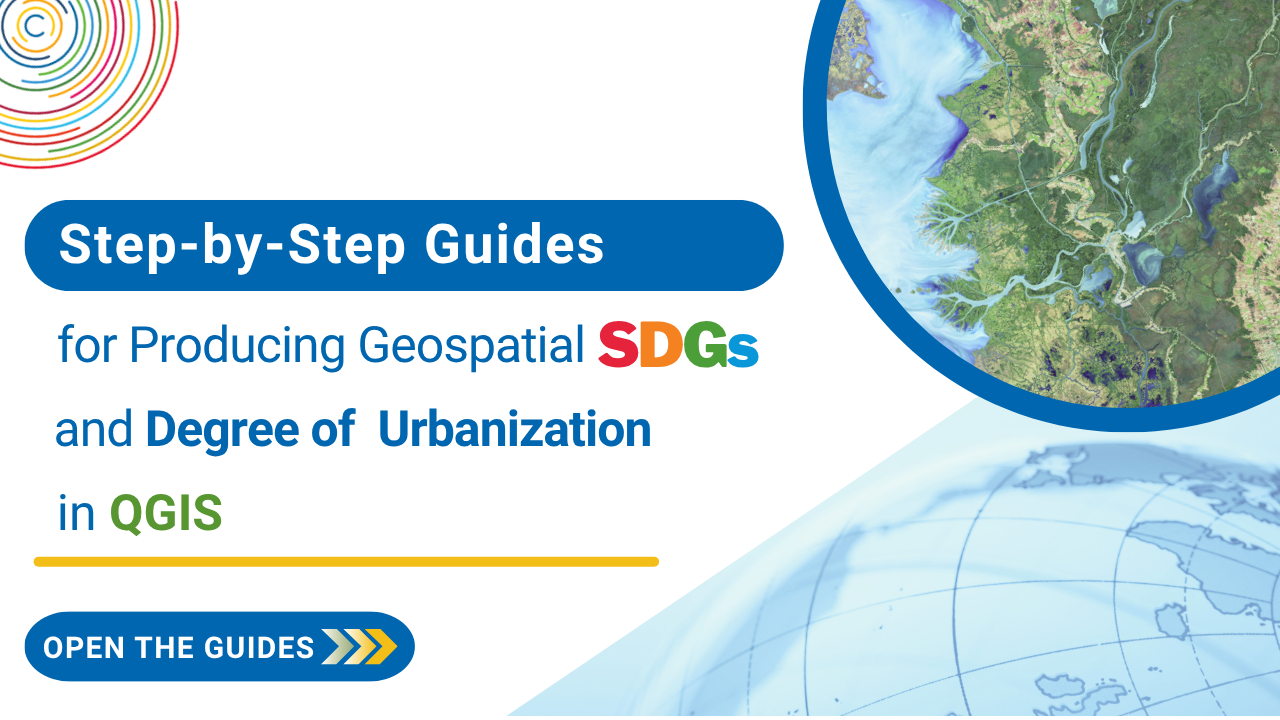
These guides are intended to support National Statistical Offices (NSOs), GIS practitioners and policy analysts in integrating statistical and geospatial data to produce robust, repeatable analyses for SDG monitoring.
Our response
In response to these needs, ESCAP is supporting NSOs in Asia and the Pacific to responsibly leverage big data, data science and AI to improve the production and use of official statistics. This includes strengthening technical and institutional capacity, developing practical guidance and tools, and convening peer learning and collaboration across the region.
-
Strengthening institutional capacity through technical assistance: ESCAP provides national and regional support to help NSOs adopt innovative data sources and AI-enabled methods across the statistical value chain. Technical assistance has included the use of sources such as satellite imagery and other geospatial data, scanner and web-scraped price data, and mobile positioning data to support the production of priority disaggregated statistics.
-
Knowledge products and practical tools: Building on the technical assistance provided to countries, and in partnership with UN and non-UN stakeholders, ESCAP has developed a series of knowledge products, including Working Papers, Stats Briefs, step-by-step guides, e-learnings and other practical tools. These resources cover topics including small area estimation using geospatial data, the use of Earth Observation data for land cover and crop estimation, and the use of alternative data sources for price statistics.
-
Regional peer learning and communities of practice: ESCAP supports peer exchange through regional events and communities. In 2025, ESCAP established a DASH (Data and Statistics Horizon) team on AI for Official Statistics to support the sharing of experience and expertise across Asia and the Pacific. Previously, ESCAP hosted a Data Integration Community of Practice (DI-CoP) from 2020 to 2024, which supported virtual peer learning and collaboration. Resources from DI-CoP remain accessible via this link.
Tools and resources

GitHub Repository for Use of Geospatial Data for SDGs

Case studies
AI for official statistics: case studies


Big data and data science for official statistics: regional synthesis report
A synthesis of national experiences with big data and data science across Asia and the Pacific statistical systems.
Rice estimation using earth observation data in Indonesia
A demonstration of how satellite earth observation data can be used to estimate rice production.
Events
Show more (4)
- Big Data and Data Science for Official Statistics: Virtual Workshop for Asia and the Pacific
- Regional Workshop on Web-scraping for Consumer Price Statistics
- Regional workshop on MPD Processing and Analytics for Official Statistics
- High-Level Seminar on Integration of Geospatial and Statistical Information
Stats Cafe series on Big Data and AI
A series of expert-led conversations on leveraging Big Data and Artificial Intelligence (AI) for official statistics in Asia and the Pacific.
- Ethics, Risks and Responsibilities in Using AI 10 August 2026
Show more (15)
- Moving AI projects from proof-of-concept to production 8 June 2026
- Lessons learned from AI pilot initiatives: what worked, what didn't work, and why 30 March 2026
- Coding classification with AI 9 March 2026
- Data for AI: making official statistics AI-ready 2 February 2026
- Chatbots for statistics portals 19 January 2026
- AI and the future of National Statistical Offices 22 September 2025
- Measuring E-commerce and CPI On-line Price Collection 7 November 2023
- Using Big Data to Measure the Nexus Between Environment and Gender in Asia and the Pacific 10 April 2023
- Big Data partnership models 30 August 2021
- Big Data Governance 16 August 2021
- Machine Learning for Sentiment Analysis 26 July 2021
- Mobile phone data for official statistics – addressing data accessibility, privacy, and regulatory issues 5 April 2021
- Use of satellite data in statistical institutions 15 March 2021
- Data Integration 16 September 2020
- The Prospect of Big Data for Official Statistics in Asia and the Pacific 17 August 2020

