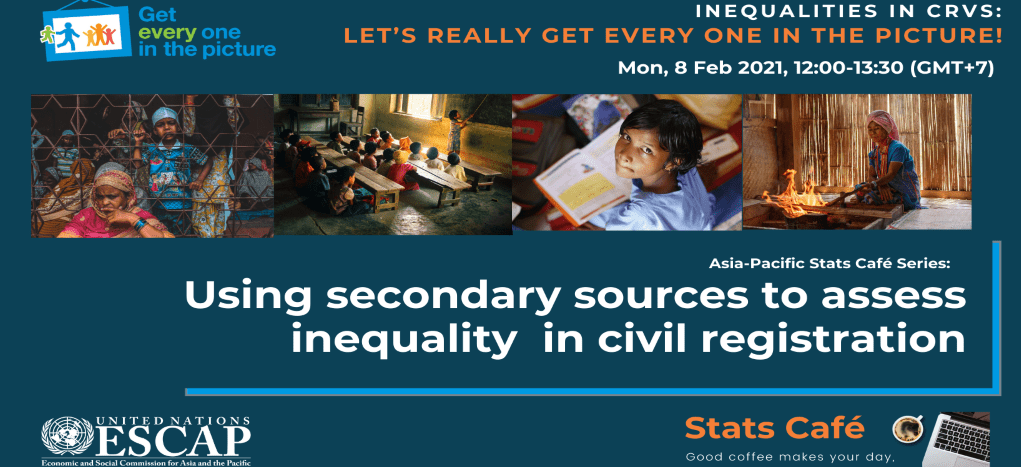
The Virtual Experts’ Group meeting on using secondary sources to assess inequality in civil registration will take place on 11 and 12 February, 2021, 11:00 – 14:00 Bangkok time (GMT +7).
About the session
A well-functioning civil registration and vital statistics (CRVS) system helps to ensure that every person has a legal identity, facilitating access to the benefits and protections of the State. Despite national and universal efforts to “get every one in the picture”, disparities in coverage of hard-to-reach and marginalized populations remain. Therefore, the Regional Action Framework on CRVS goes beyond the measurement of civil registration completeness at the national level and includes inequality assessment as part of the essential tools for achieving universal and well-functioning civil registration systems.
While many countries expressed willingness to undertake inequality assessments, they often struggle to understand how these should be undertaken, especially where capacity is low. The COVID-19 pandemic and the disparities in its impact have highlighted the importance of death registration to be able to measure and report on this. The pandemic underscored the importance of ensuring that CRVS systems are strengthened and improved, to respond better to any future pandemic, and have a better understanding of the ensuing mortality and morbidity. Assessing inequalities in civil registration is required to strengthen CRVS systems.
This session will hear experts discuss the secondary sources which might be used to assess inequality in civil registration. These sources can include population and housing censuses, household surveys and administrative data such as that from health and education information systems, health and demographic surveillance sites and sample registration sites. Sharing their experiences and perspectives, the session will explore questions such as:
- What are the advantages and disadvantages of the different data sources for assessing inequality in civil registration?
- What are the criteria for determining which data sources are the most appropriate, when are they appropriate to be used, which assumptions are made and do those assumptions hold?
- How may these data sources be improved to be a better resource for assessing inequality?
This is the second of a three-webinar series which will be conducted to provide vital inputs to the three associated Expert Group Meetings. The activities ultimately hope to provide practical and clear guidance for countries in Asia and the Pacific with lower capacity on filling the gap in inequalities in CRVS.