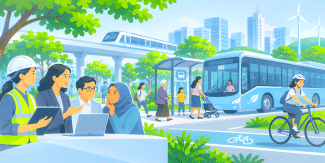
Explore the Knowledge Bank


Transport systems play a central role in economic development, social inclusion, and climate action, yet they are not gender neutral. Women and men experience transport differently as users, workers, and decision-makers, and these differences are amplified by climate change impacts such as extreme weather events, infrastructure disruption, and health risks. Gender gaps in transport stem from larger gender gaps in society, mostly concerning the gendered division of unpaid care and reproductive labour, which has led to the creation of the term “mobility of care”. Understanding the gender dimension of transport and using that information to guide transport policy is essential to achieve effective, equitable, and resilient climate action.
While international frameworks, including the United Nations Framework Convention on Climate Change (UNFCCC) and the new Belém Gender Action Plan (GAP), call for the integration of gender equality into climate policies, implementation within the transport sector remains uneven. Key challenges include limited access to gender-disaggregated data, insufficient institutional capacity, fragmented policy approaches, and a lack of practical tools to support action.
To respond to these gaps, the United Nations Economic and Social Commission for Asia and the Pacific (ESCAP), under its United Nations Development Account project on "Strengthening Capacity of ESCAP Member States to Implement Low Carbon and Resilient Transport Action Plans in Asia and the Pacific" (2025–2028), has developed a Knowledge Bank on Gender Equality, Transport and Climate Change. The Knowledge Bank will serve as an interactive digital resource to support policymakers and practitioners in advancing gender-responsive transport and climate action across Asia and the Pacific.
The Knowledge Bank aims to strengthen the capacity of ESCAP member States to design and implement gender-inclusive, low-carbon, and climate-resilient transport policies and action plans. Its objectives are to:
● Improve understanding of the gender–transport–climate nexus
● Support evidence-based policymaking through access to relevant data
● Share country examples and good practices aligned with the UNFCCC Gender Action Plan
● Enhance capacity building through targeted training materials and resources
● Promote regional knowledge exchange and peer learning
The Knowledge Bank is organized around four interconnected pillars.
1. Understand: Provides short thematic explanations and curated readings on key issues, including access and mobility gaps, climate resilience of transport networks, health impacts, workforce diversity, decision-making representation, finance barriers, and research and data gaps.
2. Data: Compiles data sources and indicators to support evidence-based policy and benchmarking, structured around the UNFCCC Gender Action Plan priority areas such as capacity building, gender balance and leadership, safety, planning and infrastructure, workforce diversity, and climate resilience.
3. Take Action: Showcases country-level actions and policy measures, organized according to the UNFCCC Gender Action Plan, including governance frameworks, finance and investment, implementation, and monitoring and reporting.
4. Training and Resources: Provides practical guidance, toolkits, training materials, and learning resources, aligned with the same UNFCCC Gender Action Plan structure to ensure coherence and ease of use.