Sorry, you need to enable JavaScript to visit this website.
Skip to main content

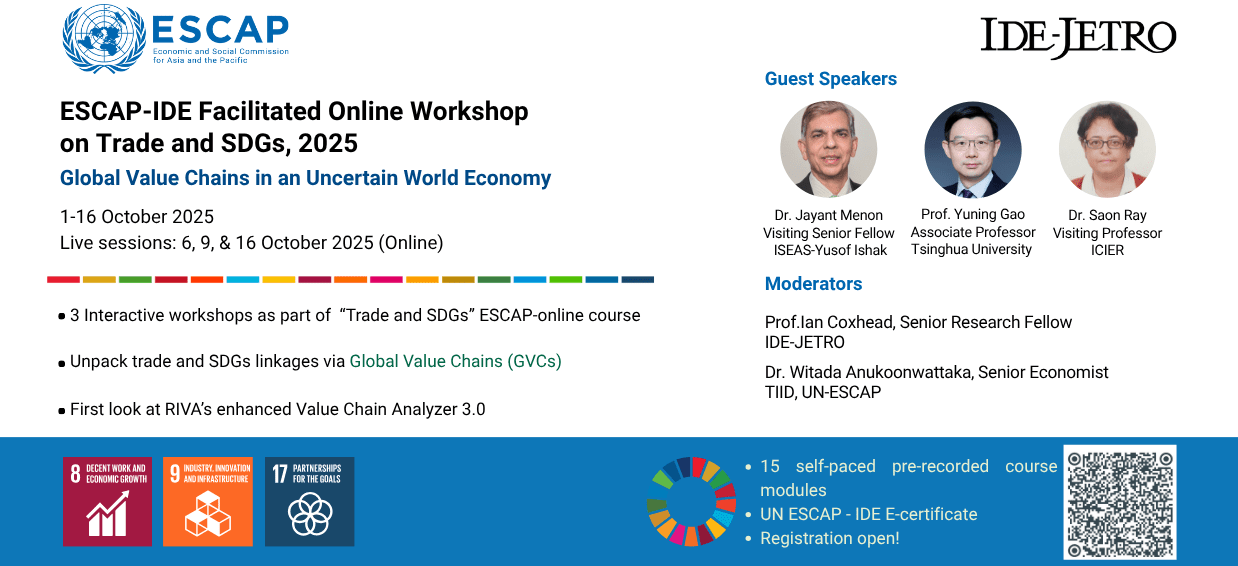
01 to 16 Oct 2025 | Open meeting

Banner

Trade integration provides many development opportunities, but its benefit for sustainable development is not automatic. Understanding and managing the risks that come with trade openness is not straightforward. It requires at least a conceptual understanding of the linkages between trade and sustainable development—both the opportunities it creates, and the threats that it poses. This workshop aims to enhance the general public and policymakers' understanding of the relationship between trade and SDGs. It gives a broad perspective on trade's enabling and disenabling roles in achieving the 2030 Agenda for Sustainable Development.

This year’s workshop will explore these connections through the lens of Global Value Chains (GVCs). The thematic session will discuss how the shifting global value chain landscape will reshape the relationship between trade and SDGs, and how countries can navigate these changes to achieve sustainable development.

Workshop format and content

The workshop includes 15 pre-recorded modules (approximately 15 minutes each), readings, and online quizzes to be completed over a two-week period. Three live sessions, each lasting 60 to 90 minutes, will be held for deeper discussions with the course facilitator and distinguished guest experts. You can find the course programme under the ‘DOCUMENTS’ tab.

First live session: 6 October 2025, 14:00-15:00 hrs (UTC+7)
This session offers participants an opportunity to discuss course materials and their practical applications with the course facilitator. Participants are expected to complete at least the four introductory "A" modules before attending the first session on 6 October.

Second live session: 9 October 2025, 14:00-15:15 hrs (UTC+7)
This session will make participants familiar with the thematic subject of this year’s workshop by introducing relevant course materials and other resources. Participants should continue studying the online video modules and complete the GVC video module (C.2) before attending the second session on 9 October.

Third live session: 16 October 2025, 14:00-15:30 hrs (UTC+7)
This session will feature a thematic discussion, allowing participants to broaden their perspectives and apply conceptual knowledge to real-world issues. This year’s theme will focus on trade and GVCs. Participants should have completed all main modules, and MUST have completed the GVC module “C.2” before attending the third session on 16 October.

Certificate and requirements

UN-ESCAP and IDE-JETRO will issue an e-certificate for your successful completion of all mandatory modules (A, B, C). Successful completion requires 1) attending ALL live sessions, 2) submitting the workshop feedback online survey, and 3) passing all module quizzes with at least 75% before 1 December 2025. 

Those who met these requirements will receive an e-certificate sent by email within 30 days after the quiz deadline (31 December 2025).

Access to the self-learning materials

To access the self-learning materials, please CLICK and register for the workshop on “Trade and Sustainable Development Goals” which is hosted on the ESCAP Community platform.

For more information about the course, please visit ESCAP E-learning course CLICK.

Access the new and enhanced RIVA’s Value Chain Analyzer 3.0 at RIVA | Regional Integration & Value Chains Analyzer


Dr. Jayant Menon
Dr. Jayant Menon
Know More

Jayant Menon is Visiting Senior Fellow at the ISEAS-Yusof Ishak Institute in Singapore, starting February 2020, following a long career at the Asian Development Bank (ADB) in Manila. At ISEAS, he continues his work on trade and investment issues in the region but with more of a research focus, and co-edits the Journal of Southeast Asian Economies (JSEAE). 

Prior to this, he was Lead Economist (a Director-level post) in the Office of the Chief Economist at ADB. He joined ADB in 1999 and has worked on the India Desk, the Regional Economic Monitoring Unit, the Southeast Asia Department, and the Office for Regional Economic Integration. He was Senior Research Fellow at the ADB Institute in Tokyo from 2005 to 2008. 

One of his key accomplishments at ADB was to develop the International Trade stream and assemble a Trade team, which he led. He was also invited by the Royal Government of Cambodia to prepare a long-term strategic vision for the country, Cambodia Vision 2030.

Prior to joining ADB, he worked as an academic in Australia for more than a decade, mainly at the Centre of Policy Studies at Monash University at its original campus in Clayton, Melbourne. CoPS is world renowned for CGE modeling. He has also worked at the University of Melbourne, Victoria University, and the American University in Washington, DC.

He holds adjunct appointments with the Australian National University, University of Nottingham, UK and IDEAS, Malaysia. He has served as a Board Director of CDRI, Cambodia and on the Advisory Board of the University of Nottingham, Malaysia. 

He serves on the editorial board of several academic journals including the Journal of Asian Economics, Asian Economic Journal, Journal of Asian Economic Integration and Foreign Trade Review, among others. He is the Book Review Editor for the Journal of Asia-Pacific Economy.

He has authored/edited 15 books, more than 50 chapters in books and 80 articles in peer-reviewed journals. These works have been cited more than 300 times based on the Social Science Citation Index and 5000 times based on Google Scholar. His most widely cited work examines the relationship between exchange rates and prices and the top two papers were published in The Economic Journal. 

He holds a Bachelor of Economics with Honours (First Class) from La Trobe University, and a Masters and a Ph.D in Economics from the University of Melbourne.

Prof. Yuning Gao
Prof. Yuning Gao
Know More

Yuning Gao is a Tenured Associate Professor and Deputy Dean at the School of Public Policy and Management, Tsinghua University, and Director of the Institute of International Development and Global Governance. He holds a Ph.D. in Economics from the University of Cambridge. His research focuses on global value chains, international development, and sustainable economic governance. Dr. Gao serves as a member of the IDE-WTO GVC Project. He has published extensively in journals such as Nature Communications, One Earth, Energy Economics, World Development, and China Economic Review.

Dr. Saon Ray
Dr. Saon Ray
Know More

Dr. Saon Ray is a Visiting Professor at the Indian Council for Research on International Economic Relations (ICRIER), New Delhi. She is an economist specializing in industry and international trade issues. Her areas of interest include global value chains, low carbon growth and financial inclusion. She earned her Ph.D. in Economics from Jawaharlal Nehru University in 2001, where she studied the impact of intellectual property rights on technology transfer to developing countries. Her latest book is "A Primer on Electric Vehicles in India: A Machine-Generated Literature Overview" (co-edited) from Springer. She is also the author of "Global value Chains and the Missing Link: Cases from Indian Industry" (Routledge, 2018). 

Prof. Ian Coxhead
Prof. Ian Coxhead
Know More

Professor Ian Coxhead has a 32-year career teaching and researching development economics. His research focuses on problems of globalization, growth, and development, mainly in East and Southeast Asia. Currently, he is a Chief Senior Researcher at the Institute of Developing Economies (IDE-JETRO), an emeritus professor of the Department of Agricultural and Applied Economics at the University of Wisconsin-Madison, and an honorary professor in the Arndt-Corden Department of Economics, Australian National University. He is also a member of the inequality measurement, interpretation, and policy network in the Human Capital and Economic Opportunity Global Working Group at the University of Chicago.

Dr. Witada Anukoonwattaka
Know More

Ms. Witada Anukoonwattaka serves as Economic Affairs Officer for the Trade Policy and Facilitation Section of the Trade and Investment Division at the United Nations ESCAP. She possesses extensive experience in trade policy research and has implemented capacity-building initiatives focused on trade, investment, and digital trade policies. Witada is the coordinator and leads TIID research projects and capacity building activities in the areas of digital trade, global value chains, and the interactions between trade and the Sustainable Development Goals (SDGs).  Recently, she led the background research and the preparation of the Asia-Pacific Trade and Investment Report 2023. This joint ESCAP-UNCTAD-UNIDO publication is dedicated to the theme of unleashing digital trade and investment for sustainable development. In addition, she is the coordinator for the ESCAP-ECA-ECLAC joint initiative on digital trade regulatory analysis and collaborates with the ESCAP-OECD on research pertaining to digital trade policies in Asia and the Pacific. Before joining ESCAP, she was a lecturer of the Faculty of Economics at Thammasat University, Thailand, and also worked  in the advisory team of Thailand’s minister of industry, foreign affairs, and commissioner of Thailand’s National Telecommunications Commission. She holds a Ph.D. in Economics from the University of Melbourne, Australia.

for more information, please contact

Trade, Investment and Innovation Division +66 2 288-1234 [email protected]
Print this page