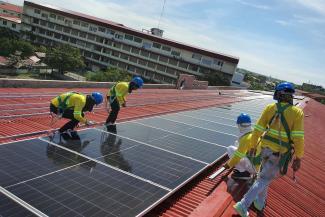
A renewable energy start-up in the Philippines is leveraging government support and cooperation with ESCAP to attract investment, propelling its ambitions to become a key player in the country’s renewable energy transition.
Like many start-ups in the Philippines, Zenith Renewable Energy Company (ZREC), specializing in solar PV projects, was founded without external investors, pooling its initial funding from the families of founding members. Since its establishment in 2022, ZREC has gradually expanded to make its mark on the country’s advancing solar energy sector. Although a relative newcomer to the industry, the company has started developing utility scale solar projects, and has recently branched out into wind energy, with plans to introduce low flow wind turbine technology to the Philippines.
According to Aris Tulalian, CEO and President of ZREC, the company’s close collaboration with the Board of Investments (BOI) under the Philippines Department of Trade and Industry has been pivotal to its expansion. “Investment Promotion Agencies (IPAs) like BOI look out for our best interests when it comes to securing investment, and they are responsive to our feedback, especially on policies that drive improvements and efficiency,” says Tulalian. “When investors make enquiries, we involve BOI to provide their insight into the Philippine investment landscape. Their involvement also allows investors to review our track record, promoting transparency and trust.”
Tasked with attracting and facilitating investment, IPAs operate at the intersection of policy and the private sector, with an increasingly important role in identifying and promoting investment-ready opportunities in green sectors and attracting green Foreign Direct Investment (FDI).
Greenfield FDI has emerged as the most significant source of climate finance in the Asia-Pacific region, constituting a vital source of long-term financing for the region’s transition to low carbon economies. Between 2016-2023, the region received US$329 billion in climate-related greenfield FDI, compared to US$ 183.7 billion from official development assistance and multilateral development funds combined over the same period. In the Philippines, BOI has introduced various initiatives and policies to help companies like ZREC to seize these opportunities, including efforts to streamline permitting processes and incentivise investment in renewable energy. However, challenges remain for companies in the Philippines, and developing countries across the region, in attracting investment and meeting the necessary requirements, particularly for FDI.
Highlighting the Government’s continued efforts to liberalize foreign ownership, Lanie Dormiendo, Director of International Investments at BOI, emphasizes the importance of FDI in advancing sustainable development in the Philippines. “There is a significant investment gap for green projects, not just in the Philippines, but globally. FDI will be critical in bridging this gap, while driving green technological innovations and transferring new knowledge and expertise into the country,” says Dormiendo. “However, many companies, particularly medium sized enterprises, lack investment readiness. While some have project proposals in place, there is a need to strengthen supporting documentation and improve overall project packaging,” she explains.
To tackle this challenge, ESCAP, under its ASEAN Green Investment Catalyst (AGIC) Project, is working with IPAs in the region to build their capacity to identify and package investment-ready green projects. To this end, a project documentation template, tailored to the renewable energy sector, has been developed for IPAs to use in their work with project developers, ensuring a consistent, professional approach to presenting credible opportunities to investors.
BOI has recently piloted the tool with ZREC to prepare documentation for a 49.9MW ac solar PV project, as well as well as supporting another medium-sized company, Mabuhay Power Holdings (MPH), with its 76.65MW ac solar power project. “It’s hugely beneficial to have a comprehensive template to guide us in helping companies to prepare for investment. BOI’s collaboration with ESCAP has been instrumental in building institutional capacity, not just in vetting and packaging investment ready projects, but in FDI attraction more broadly,” says Dormiendo.
Having completed the documentation process, ZREC and BOI recently presented their project to a global audience of investors and development partners at the SDG Investment Fair during the fourth Financing for Development Conference, and the company went on to submit the project document to a prospective investor. “They appreciated the detailed information and how it is presented – it’s clearly not an AI-generated document but prepared by someone who has seen the site. This really makes a difference, so we’ll be replicating this format for our other projects,” explains Tulalian.
Moving forward, ZREC is actively seeking diversified and expanded investment in its projects, with ongoing support from BOI to build its network. With increasing investment opportunities on the horizon, the growing company plans to pursue ambitions to become an independent power producer, charting a path to the forefront of the renewable energy transition in the Philippines.
The ASEAN Green Investment Catalyst project aims to accelerate ASEAN's green transition by increasing Foreign Direct Investment into renewable energy, energy efficiency and other key green sectors, in line with the ASEAN Regional Investment Promotion Action Plan. The Project is funded by the UK Mission to ASEAN under the ASEAN-UK Green Transition Fund, and implemented in collaboration with the ASEAN Secretariat (Services and Investment Division), the ASEAN Coordinating Committee on Investment and Investment Promotion Agencies from the region.