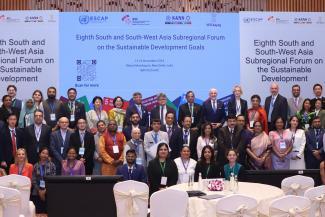
The eighth South and South-West Asia Subregional Forum on the Sustainable Development Goals began today with a strong call for renewed commitment, accelerated efforts and innovative solutions to meet development ambitions. This gathering of policymakers and representatives from various stakeholder groups follows September’s Summit of the Future where global leaders adopted the Pact for the Future, emphasizing international cooperation to achieve shared goals and tackle new challenges.
The three-day Forum will focus on five key SDGs - Goal 3 on health and well-being, Goal 5 on gender equality, Goal 8 on decent work and economic growth, Goal 14 on life below water, and Goal 17 on partnerships.
“We must address the multi-dimensional challenges to our health. We also must ensure that women and girls have equal opportunities in economic, social and political spheres and enable their empowerment,” said UN Under-Secretary-General and Executive Secretary of the Economic and Social Commission for Asia and the Pacific (ESCAP) Armida Salsiah Alisjahbana in her opening remarks.
She further called for countries to renew commitments to achieving inclusive and sustainable growth, creating productive jobs and protecting employment conditions for all workers, while underscoring that “South and South-West Asia has a youthful population and generating employment for youth is a priority.”
Representing the host government, Suman Bery, Vice Chairman of NITI Aayog underlined the value of SDGs in providing a holistic view of the development process and the essentiality of regional cooperation for mutual learning. He emphasized that “The relationship between the organs of government and the private sector is important for growth and the achievement of SDG 8 and SDG 17. The interface between the bureaucracy and the private sector will turn out to be a very important element for the next phase of growth. That to me is the new frontier.”
Md. Golam Sarwar, Secretary General, SAARC Secretariat highlighted, “Achieving the 2030 Agenda will require an ambitious, comprehensive, holistic and transformative approach. It will also require enhanced and revitalized regional and global partnerships in addressing resource, technology and investment gaps. In addition, there is a strong need to recognize the importance of addressing the diverse needs and challenges faced by countries in special situations.”
Shombi Sharp, UN Resident Coordinator, exemplified the innovations and wide-scale national and subnational initiatives in India such as the SDG Index system and the opportunities for South-South cooperation that India offers. Meanwhile, Vinod Paul, Member, NITI Aayog illustrated India’s efforts and results in advancing health and SDG 3.
Progress towards attainment of the SDGs in South and South-West Asia has been uneven, especially in the face of multiple, intersecting global crises and large populations being affected by natural disasters. Forum participants are expected to review progress as well as develop concrete recommendations on several pressing issues such as environmental protection and ecological conservation of water bodies, persistent informal employment, and gender and youth employment gaps.
Convened by ESCAP, in collaboration with the Government of India, Research and Information System for Developing Countries, a policy institute, and the UN Resident Coordinator’s Office, the meeting is part of a series of five subregional forums which serve as a collaborative platform for governments, development partners, civil society, and other stakeholders to assess progress on the 2030 Agenda and identify solutions. Inputs from the subregional forums will feed into the 12th Asia-Pacific Forum on Sustainable Development (APFSD) and global UN High-Level Political Forum (HLPF) in 2025.
For further information: https://www.unescap.org/events/2024/eighth-south-and-south-west-asia-subregional-forum-sustainable-development-goals
For media enquiries or expert interview requests, please contact:
Li Stephanie Choo
Social Affairs Officer
ESCAP Subregional Office for South and South-West Asia
E: [email protected]