

Care is fundamental to how societies and economies function, yet the conditions in which care is provided are changing rapidly. As demographic, technological, environmental and social changes reshape care needs and arrangements, decisions made today will shape how care is valued, provided and shared for generations to come.
The future is care: visioning inclusive and resilient care systems in Asia and the Pacific uses strategic foresight to connect the legacies of the past, the pressures of the present and the possibilities of the future. By exploring multiple plausible futures, it examines the different directions care systems might take and identifies pathways towards a more inclusive and resilient future.
Applying strategic foresight to care
Care systems are built slowly and felt over generations: decisions taken today will shape well-being and social norms decades from now — yet the world those decisions will inhabit cannot be fully known.
This publication takes this uncertainty as its starting point and brings three unique contributions:
- Strategic foresight
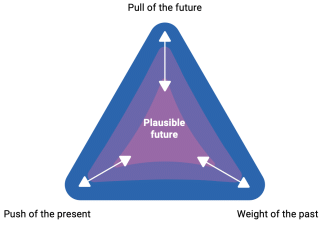
This publication breaks new ground by applying strategic foresight to the care economy in Asia and the Pacific, using the Futures Triangle to connect the weight of the past, the push of the present and the pull of the future, and asking not only why care matters and what is reshaping it, but what futures may lie ahead and how the region can prepare.
@ESCAP
- A systems perspective
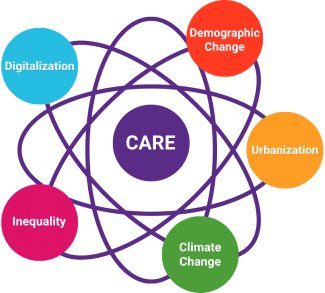
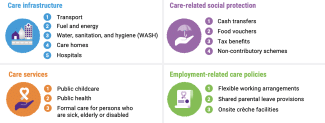
This publication takes a comprehensive view of care across infrastructure, services, social protection and employment-related policies, while examining how demographic change, digitalization, urbanization, climate change and inequalities are reshaping care.
- From foresight to action
This publication translates foresight into practical pathways for building more inclusive and resilient care systems, and stress-tests those pathways against different plausible futures.

The weight of the past: why care systems remain unequal and fragmented
The way care is organized across Asia and the Pacific is not natural or inevitable. It reflects decades of accumulated policy choices, economic models and social norms that continue to shape how care is valued, funded and shared. These inherited structures influence who provides care, who receives it and how responsibilities are shared across households, markets, communities and the State.
Three interlocking historical legacies continue to shape care systems across the region.
-
Unpaid care and domestic work have long been excluded from conventional economic measurement, obscuring their scale, distribution and contribution to economies and societies.
-
Care responsibilities have developed across fragmented institutions and have often been treated as recurring expenditure rather than social investment.
-
Gendered norms of family, kinship, work and intergenerational obligation continue to assign care disproportionately to women and undervalue paid care workers.
What is excluded from measurement and monitoring is easier to overlook in policy and implementation; what is framed as a private family responsibility is easier to leave outside public investment and underfund; and what is associated with women’s “natural” role is easier to undervalue. Together, these legacies make historically created arrangements appear private, natural and difficult to change.
The push of the present: megatrends shaping care
Care systems across Asia and the Pacific are being reshaped by interconnected megatrends: demographic change, digitalization, urbanization, climate change and environmental degradation and inequalities. These megatrends do not operate separately. Their interaction changes both the demand for care and the capacity of families, communities, workers, and institutions to provide it.
Care and megatrends
Five megatrends:
- Demographic change is increasing and diversifying demand for care across the life course while reshaping the availability of family and paid caregivers.
- Digital technologies create both opportunities and risks for access to delivery and governance of care, as well as for the conditions under which care workers are employed.
- Urbanization and changing family structures are reshaping traditional caregiving arrangements, where care needs arise and how caregiving responsibilities are organized.
- Climate change and environmental degradation, including rising temperatures, disasters, pollution and other environmental pressures, are intensifying care needs and vulnerabilities.
- Widening inequalities shape exposure to care risks, access to infrastructure and services and the capacity to provide care, magnifying the effects of every other megatrend.
The care landscape in Asia and the Pacific: systems, gaps and emerging responses
Building on ESCAP’s Model Framework for Policy Action on the Care Economy the regional care landscape can be understood across four policy areas.
Policy categories of care
Care systems across Asia and the Pacific reflect a diverse and uneven landscape shaped by differing demographic, social, economic and environmental realities, institutional capacities and policy frameworks. While important progress has been made in some contexts, many systems continue to rely heavily on unpaid and informal care and domestic work, with uneven access to infrastructure, fragmented services, insufficient social protection coverage, and gaps in employment-related care policies.
The pull of the future: four futures for care in 2040
The future of care in Asia and the Pacific cannot be understood through linear projections alone. Demographic change, technological transformation, urbanization, climate pressures and widening inequalities, as well as evolving social norms may interact in ways that produce very different trajectories for care systems across the region.
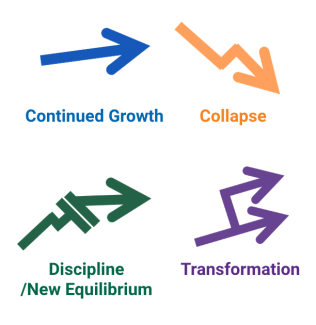
No one can predict the future, but it can be explored in a disciplined way. Using Jim Dator’s four-archetype method, the publication sets out four scenarios for the future of care in Asia and the Pacific, not to forecast a single outcome but to prepare for several.
Foresight approaches
The scenarios were developed through a structured consultation with experts from Asia and the Pacific and beyond. In April and May 2026, six focus group discussions brought together 25 participants from United Nations entities, international and civil society organizations, governments and independent experts.
In parallel, a participatory foresight workshop convened by ESCAP at the Women Deliver 2026 Conference (Melbourne, April 2026) brought together some 20 policymakers, development partners, civil society representatives and researchers to explore the same four scenario archetypes. Insights from the workshop complemented the focus group discussions and informed the development of the scenario narratives. The resulting scenarios and emerging findings were subsequently presented for discussion at the 12th Asia-Pacific Futures Network (APFN) Conference (Bangkok, September 2026).
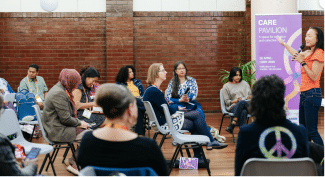
Women Deliver 2026 Conference © GAC
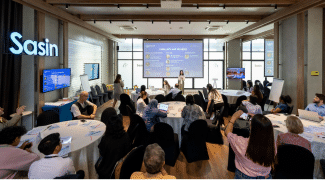
12th Asia-Pacific Futures Network (APFN) Conference © Sasin
As products of this consultation process, the scenarios are not intended to provide comprehensive or representative descriptions of all possible care futures in Asia and the Pacific, but to offer plausible renderings of how different drivers of change could interact under each scenario archetype.
Continued growth
The current trajectory continues and expands, intensifying both existing strengths and unresolved problems. It is not simply business as usual, but an extension of the direction already underway.
Here, many things have improved: care services reach more people, digital tools make coordination easier, and family leave and other forms of public support are more widely available. But those systems still have limits — not every place is covered, not every service is available at the right time, and families are still expected to fill what falls between them.
Collapse
Accumulated pressures push care systems, infrastructure and informal support networks beyond their limits, leading to breakdown, loss of capacity and uneven forms of survival and adaptation.
In this future, public systems and formal care services are breaking down under multiple pressures, but the need for care has not disappeared. Instead, more and more of it falls back on families, informal workers and community networks — and people with money and resources are much better protected than those without them.
Discipline / New equilibrium
Societies respond to constraint by seeking stability, balance and control. Care is reorganized around limits, rules and managed provision, which may improve some outcomes while reducing flexibility and choice.
This is a much more organized world. Society has reorganized around sustainability and shared limits, and care is better funded and more professionalized — but that stability also comes with tighter rules, rationing, digital monitoring and less individual freedom.
Transformation
A radical departure from the present reshapes the wider operating environment, such as through a major technological, institutional or social shift. In this scenario, transformation does not mean that care systems themselves become ideal; it means that care is reorganized under fundamentally new conditions.
Transformation imagines a world where AI and automation have fundamentally reshaped the economy and public systems. Basic needs are much better supported and care is recognized as public infrastructure, but technology still cannot replace everything — things like trust, consent, safe touch, human judgement and simply being present.
To bring these future scenarios to life and encourage deeper engagement with the choices that shape care systems, ESCAP has developed Caring Futures Lab, an interactive, gamified policy tool. Through immersive storytelling and decision-making, participants can navigate possible care futures, explore the trade-offs of different policy choices, and reflect on how today's decisions could shape more inclusive and resilient care systems by 2040.
Pathways towards inclusive and resilient care systems in Asia and the Pacific
Building comprehensive, inclusive and resilient care systems in Asia and the Pacific will require more than incremental reforms. It will require long-term systems transformation capable of addressing persistent inequalities and responding to demographic, social, technological and environmental change under conditions of uncertainty. It will also require recognizing that care is both an economic imperative and a matter of human dignity and rights – encompassing the needs and rights of those who receive care and of those who provide it, paid and unpaid.
The publication draws on three established foresight methods – visioning, backcasting and wind-tunnelling – in deliberate sequence: from defining where we want to go, to identifying what needs to change to get there and to examining how that change agenda may need to adapt across uncertain futures.
The publication identifies four building blocks and 12 recommendations for care systems development, each containing concrete recommendations drawn from ESCAP’s Model Framework for Policy Action and the five megatrends analysed in previous chapters.
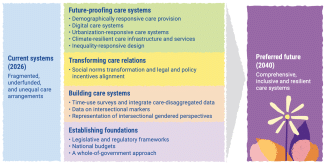
Four building blocks of development towards the preferred future of 2040
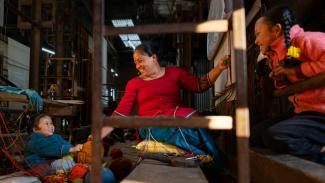
The pull of the future: reimagining care in an age of transformation
Transforming care systems requires sustained action across sectors, institutions and generations, together with a different way of valuing care, sharing responsibility and investing in the people and systems that provide it.
Advancing Transformation Through Collective Action
-
Embed care across wider policy priorities. Care should be integrated into decisions on public finance, labour markets, social protection, health, climate resilience, migration and urban development.
-
Governments have a distinctive role. They are responsible for establishing legal and policy frameworks, mobilizing public resources, setting standards and safeguarding equitable access and rights.
-
Meaningful participation is essential. People who provide and receive care, civil society, workers’ and employers’ organizations, communities, researchers and the private sector should have a meaningful role in shaping and implementing reform.
-
Regional and international cooperation can accelerate progress. Peer learning, technical cooperation, stronger evidence and capacity-building can help countries learn from one another and sustain momentum.