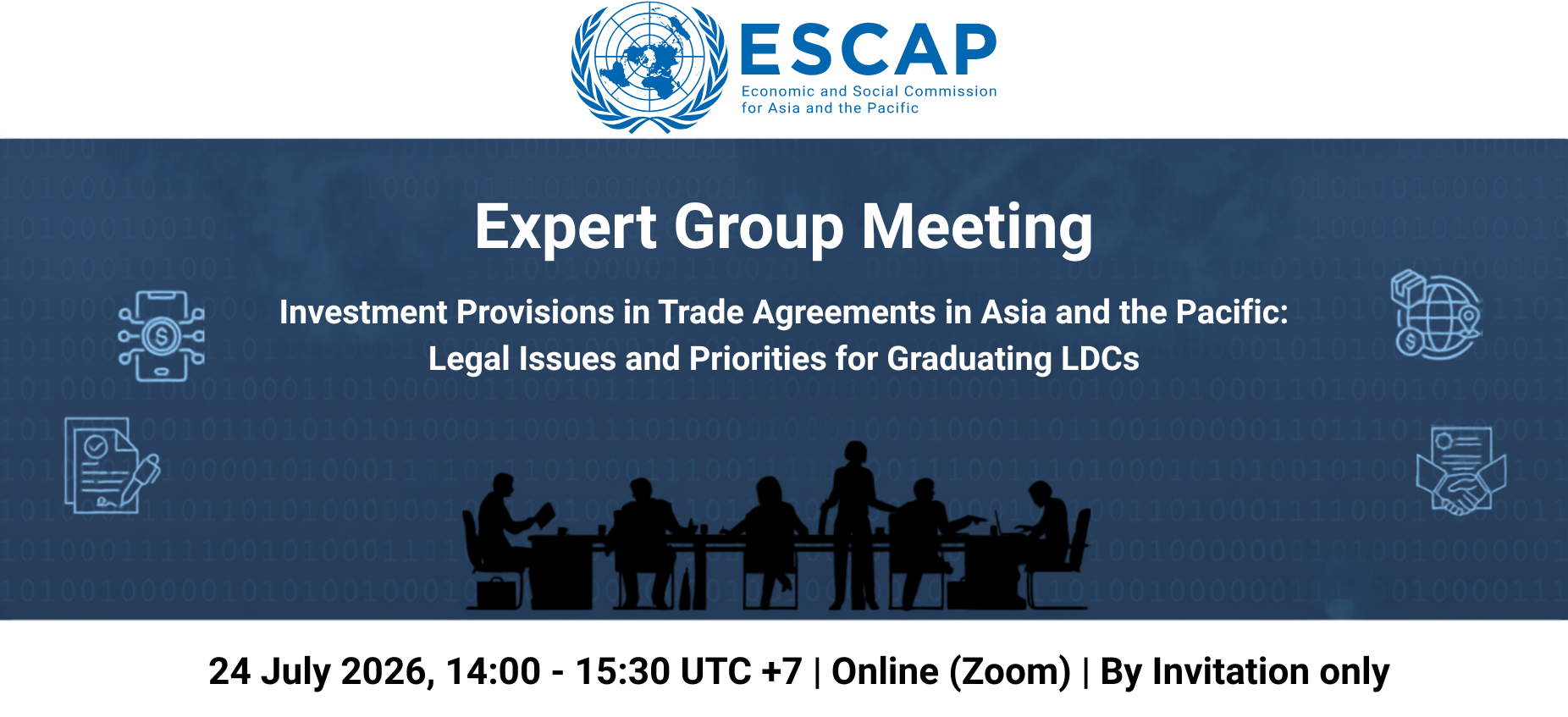
The Trade, Investment and Innovation Division (TIID) of ESCAP is hosting the first of two Expert Group Meetings (EGMs) on Investment Provisions in Trade Agreements for Graduating LDCs in Asia and the Pacific region. This invitation-only meeting brings together experts, practitioners, and officials to support graduating LDCs in strengthening their capacity for trade negotiations in investment-related areas. (see the concept note for details)
The EGMs will consist of two sessions. It aims to help identify priority investment-related issues and inform further enhancements to ESCAP's capacity-building programs and analytical tools.
Background:
Five of the ten LDCs in Asia and the Pacific are expected to graduate within the next three years, including Bangladesh, Nepal, and Cambodia. Graduating LDCs will face the gradual loss of preferential market access. As a result, these countries are increasingly seeking to strengthen their trade negotiation capacity and make more effective use of preferential trade agreements (PTAs).
For graduating LDCs, trade agreements could play a greater role in facilitating FDI by helping to create a more predictable investment environment and supporting countries’ integration into regional value chains. ESCAP supports countries through developing capacity-building courses (e.g., e-learning courses, workshops) and analytical tools for trade negotiators (e.g., Legal TINA, TINA). This EGM will gather expert inputs on how these capacity-building courses and analytical tools can be further strengthened to better support graduating LDCs in attracting FDI for sustainable development through PTAs.
Structure:
Two EGM sessions are planned. This first session will focus on legal aspects of investment provisions in trade agreements, while the second session will focus more on the economic side in relation to analyzing FDI flows.
Guiding questions:
*The following guiding questions are indicative, and the EGM does not intend to cover all.
- Trends in investment provisions:
- What are the recent trends in BITs and PTAs, and what are their implications for graduating LDCs? Given the trend of declining new formation of BITs, what are the implications for graduating LDCs? How can graduating LDCs preserve their right to regulate while providing adequate investor protection?
- What key investment-related issues in PTAs should be prioritized to focus on for graduating LDCs? (for future e-learning programmes)?
- What are the key Investor-State Dispute Settlement (ISDS)-related trends and risks that graduating LDCs should understand, including issues related to fair and equitable treatment (FET), indirect expropriation, survival clauses, among others?
- Based on these priorities, what topics should be specifically highlighted in e-learning materials to help negotiators better understand investment-related components of trade agreements?
- Private-sector (investors) perspectives:
- How do businesses view trade agreements (PTA, EPA, FTA) when making decisions on overseas investment, particularly to developing countries?
- Based on recent experiences, including the Bangladesh–Japan EPA process and investor advisory work in Southeast & South Asia, what practical impact can trade agreements have on investor confidence, business planning, and the attractiveness of graduating LDCs as investment destinations? What legal and regulatory issues most affect investment decisions in developing-country and graduating LDC contexts?
- Practical steps:
- How can graduating LDCs better prepare for negotiations, including through the possible development of model texts? What practical steps could be taken to move forward?
- How can graduating LDCs design investment provisions to balance investor protection with the right to regulate, including through clearer treaty language, exceptions, carve-outs, safeguards, and sustainable development-oriented provisions?
- Analytical tools:
- What functions in analytical tools, including Legal TINA and TINA, could be strengthened, taking into account existing platforms and country needs?