Sorry, you need to enable JavaScript to visit this website.
Skip to main content

03 Dec 2026, 11:00 - 12:00 Indochina Time / Bangkok | By invitation only

Meeting Room A, United Nations Conference Centre (UNCC), Bangkok, Thailand

Background

Indicator development sits at the intersection of statistics and policymaking, yet it is too often owned by neither. One of the central questions in policy monitoring is where the focus should be, and ultimately, what should be monitored. Amid rising expectations for an increasing amount of timely, granular, and high-quality data, this is perhaps the most consequential question a national monitoring system can ask. No country can measure everything. The choice of what to focus on is therefore the point at which policy priorities and statistical capacity must meet, in line with the commitments made in the Declaration on Navigating Policy with Data to Leave No One Behind.

Since 2021, ESCAP and the Republic of Korea, through two successive projects under the Korea-ESCAP Cooperation Fund, have explored these questions through work on indicator development. The projects have examined how countries can strengthen policy monitoring systems and ensure that monitoring frameworks remain relevant, practical and responsive to policy needs.

A decade of SDG monitoring has taught us many things. The global indicator framework has brought once-marginal issues into national monitoring and has encouraged greater alignment in national statistical systems’ outputs, with national statistical offices increasingly recognised as leaders across the wider data ecosystem. But a list of indicators alone is insufficient. Coordination mechanisms, metadata, quality assurance, reporting arrangements, and dissemination channels are the puzzle pieces that enable the most appropriate indicators to be produced consistently, understood correctly, and used more readily in decision-making.

This side event brings together country experiences from across Asia and the Pacific to consider what a decade of SDG implementation has taught the statistical community about policy monitoring, and how the capacities built over that decade can be sustained and further developed, as attention turns to what comes after 2030.

Organizers

United Nations Economic and Social Commission for Asia and the Pacific (ESCAP) and the Ministry of Data and Statistics of the Republic of Korea (MODS).
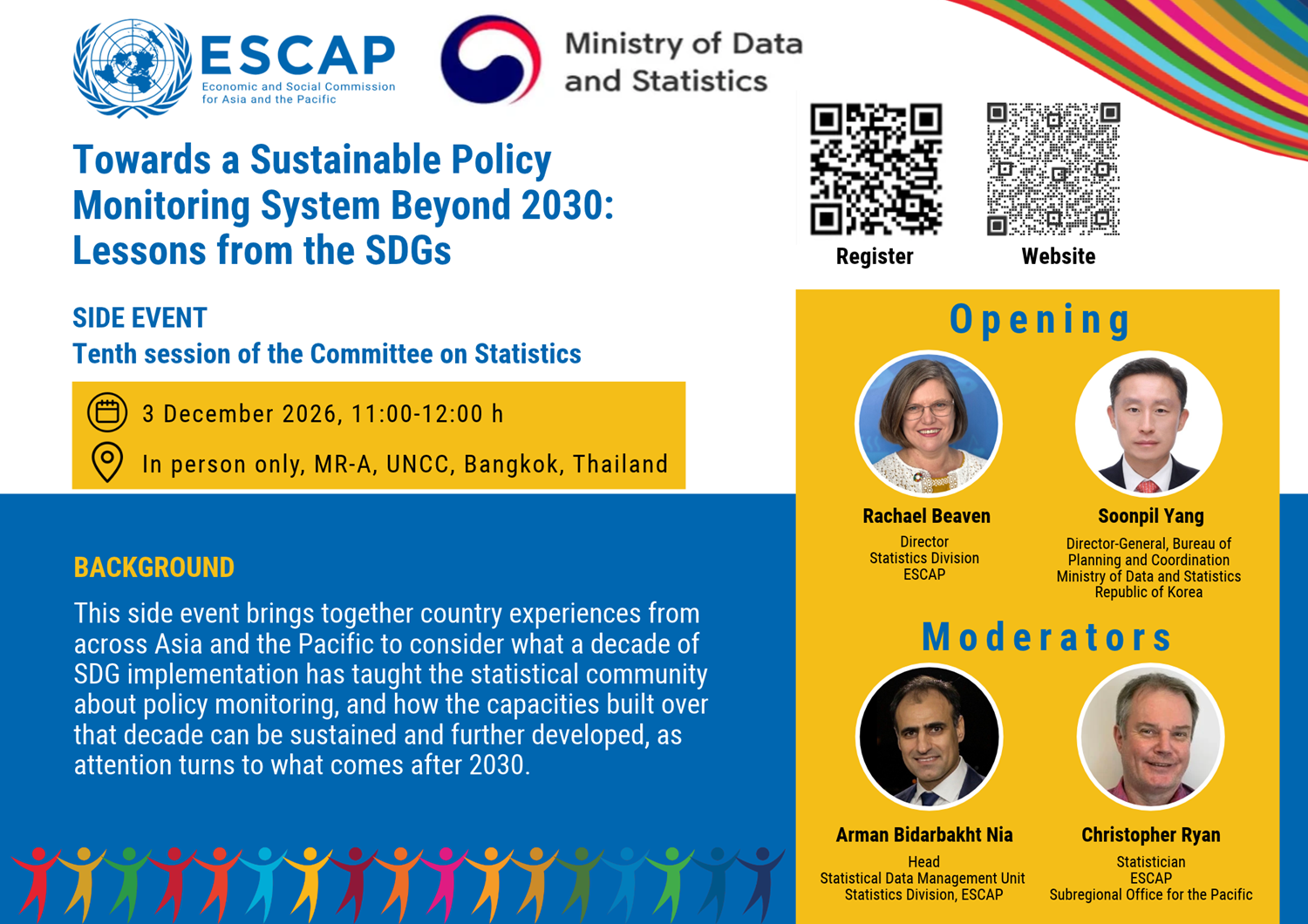
Lessons from the SDGs

  • The event is open to all participants of the Asia-Pacific Statistics Week. Online registration here or via QR code.
  • Concept note

For information, please contact Mr Dayyan Shayani, Statistics Division, ESCAP, at [email protected] with a copy to [email protected].

Registration

Asia-Pacific Statistics Week, 30 November - 4 December 2026

03 Dec 2026
11:00
11:08
Opening session
  • Ms. Rachael Beaven, Director, Statistics Division, ESCAP
  • Mr. Soonpil Yang, Director-General, Bureau of Planning and Coordination, Ministry of Data and Statistics of the Republic of Korea (MODS)
11:08
11:15
Keynote presentation
  • Mr. Arman Bidarbakht Nia, Head, Statistical Data Management Unit, Statistics Division, ESCAP
11:15
11:45
Group Discussion

Moderated by Mr. Christopher Ryan, Statistician, ESCAP Subregional Office for the Pacific

Groups will be facilitated by representatives from selected countries. Each group will have one minute to report back to the plenary.

11:45
11:55
Open Dialogue

Mr. Arman Bidarbakht Nia, Head, Statistical Data Management Unit, Statistics Division, ESCAP

11:55
12:00
Closing

Open session

Rachael Beaven
Rachael Beaven
Director, Statistics Division, ESCAP
Know More

Rachael Beaven has over thirty years of experience in government statistics, in particular data preparation and analysis. She has also worked extensively with governments, multilateral agencies and the statistical community, most notably through the United Nations Statistics Division, ECA, ESCAP, World Bank and Paris21.

Ms. Beaven has provided a wide range of technical support, from improving economic and financial statistics to estimating local population using geospatial data. She is one of the founders of the Inclusive Data Charter, launched at the 2018 High-Level Political Forum, to mobilize political commitments and to advance inclusive and disaggregated data. Ms. Beaven also led a programme on monitoring the Sustainable Development Goals with the United Nations Statistics Division and established a data science hub with the Office for National Statistics of the United Kingdom to explore the use of data science, in particular geospatial as well as big data, to monitor progress.

Ms. Beaven holds Master’s degrees in Statistical Applications in Business and Government as well as Business Administration, and a Bachelor’s degree in Geography and Geology.

Soonpil Yang
Soonpil Yang
Director-General, Bureau of Planning and Coordination, Ministry of Data and Statistics of the Republic of Korea (MODS)
Know More

Moderators

Arman Bidarbakht Nia
Head, Statistical Data Management Unit, Statistics Division, ESCAP
Know More

Arman Bidarbakhtnia leads SDG data analysis and progress assessment for Asia and the Pacific at the Statistics Division of the United Nations Economic and Social Commission for Asia and the Pacific (ESCAP). He previously served at the Statistical Institute for Asia and the Pacific (SIAP) and the Statistical Centre of Iran (SCI). His expertise spans human development measurement, poverty and consumer demand analysis, and survey methodology. He holds a PhD in Economics and an MSc in Applied Statistics.

Christopher Ryan
Christopher Ryan
Statistician, ESCAP Subregional Office for the Pacific
Know More

for more information, please contact

Statistics Division +66 2288 1234 [email protected]
Print this page