Background
Inclusive and comprehensive statistics are critical for effective national planning, offering the evidence base needed to successfully achieve the Sustainable Development Goals (SDGs). Official statistics provide the fundamental population data needed to measure progress on a broad range of SDGs—including data disaggregated by characteristics like age, sex, location, and disability status—which enable countries to monitor progress in reducing inequalities and ensure no one is left behind.
Across Asia and the Pacific, governments are strengthening national statistical systems while navigating a rapidly changing digital data environment. Yet refugees, internally displaced persons and stateless people can remain excluded, insufficiently represented or inadequately identified in censuses, household surveys and administrative data. When populations are missing from official statistics, their circumstances may also remain invisible in the policies, services and investments shaped by those data.
Statistical inclusion offers a practical response: integrating forcibly displaced and stateless populations into nationally owned data systems, applying internationally endorsed statistical recommendations and ensuring that resulting evidence can be used to strengthen public decision-making. Digital transformation can accelerate this agenda through more connected data sources, innovative collection methods and improved access to evidence. However, it can also deepen exclusion if digital systems are not inclusive by design, overlook people without documentation, connectivity, or if data are not governed with appropriate safeguards.
The proposed side event will connect statistical inclusion to the Committee’s focus on the future of national statistical offices in a digital society and the broader Asia-Pacific Statistics Week theme of building trust in official statistics. It will position inclusion, quality, privacy and responsible data use as mutually reinforcing foundations of trusted digital statistical systems.
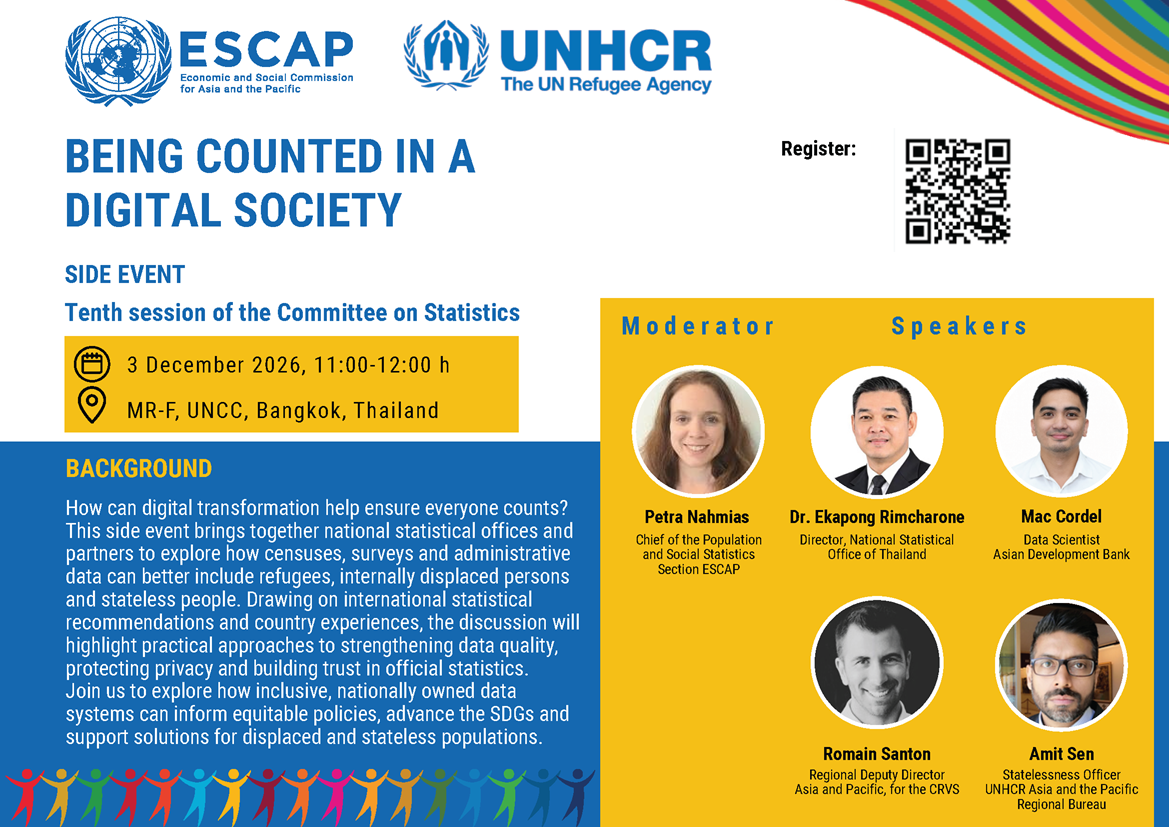
- The event is open to all participants of the Asia-Pacific Statistics Week. Participants are kindly requested to register on Indico at https://indico.un.org/event/1023597/ or via the QR code.
- Concept note

For information, please contact Alessandro Telo and Chao Huang, Regional Bureau of Asia and the Pacific/UNHCR, at [email protected] and [email protected]
Objectives
To convene a high-level, practice-oriented dialogue on how national statistical offices and partners can use digital transformation to advance the sustainable statistical inclusion of refugees, internally displaced persons and stateless people, while protecting trust, quality, privacy and national ownership.
- From invisibility to inclusion: why identifying displaced and stateless populations in national statistics matters for equitable policies, services, resource allocation and solutions.
- From standards to implementation: how international recommendations on refugee, IDP and statelessness statistics can help achieve universality in national censuses, such as Thailand NSO best practices.
- Digital opportunities: how linked administrative data, modernized civil registration systems, digital survey tools and responsible data innovation can support more timely and inclusive statistics.
- Trust and safeguards: how privacy, data protection, statistical confidentiality, transparency and meaningful engagement with affected communities can build trust whilst preventing digital exclusion and harm.
- From data to decisions: how nationally owned inclusive statistics can move beyond oneoff exercises and inform development planning, SDG monitoring and pathways towards self-reliance and solutions.
Expected outcomes:
- A shared understanding of statistical inclusion as a core component of trusted and future-ready national statistical systems.
- Practical lessons from national and regional experience on using international standards to include forcibly displaced and stateless populations in official statistics.
- A concise set of priority actions for national statistical offices, UN entities and development partners to advance inclusive, safe and sustainable digital data systems.
- Stronger visibility for existing international standards, country commitments and opportunities for regional peer exchange and cooperation.