Sorry, you need to enable JavaScript to visit this website.
Skip to main content

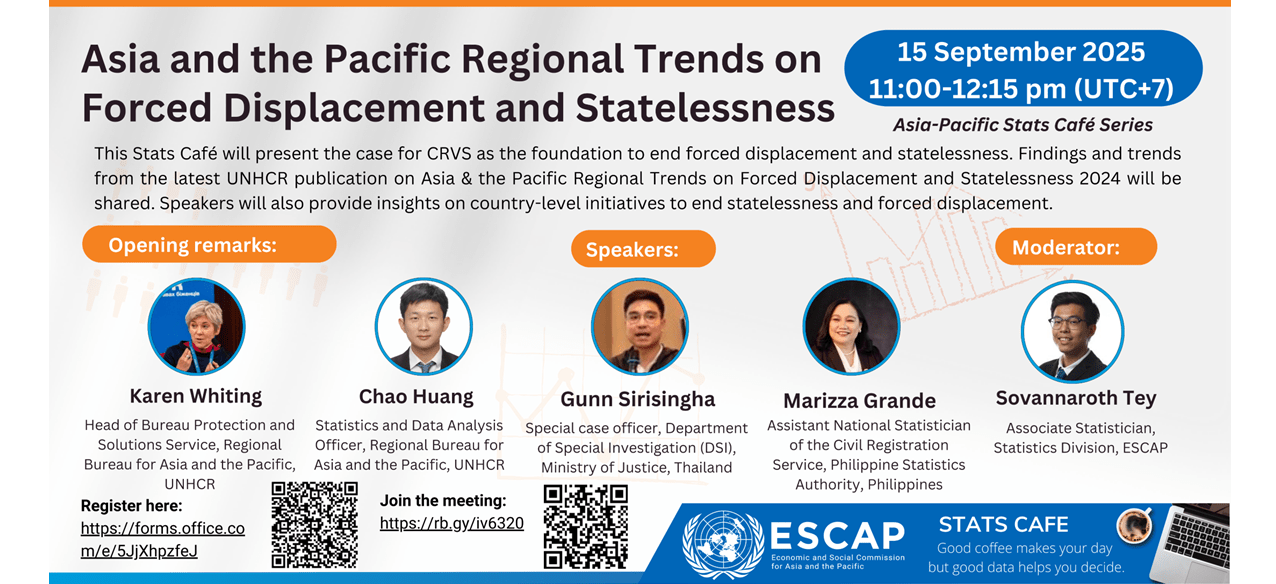
15 Sep 2025, 11:00 - 12:15 Indochina Time / Bangkok | Open meeting

Stats Cafe_15Sep2025

The Asia-Pacific region continues to face multifaceted and evolving displacement challenges. From large-scale emergencies requiring immediate humanitarian assistance to long-standing protracted situations demanding sustainable solutions, millions of people in the region remain uprooted from their homes. The majority of refugees seek safety in neighboring countries, many of which are low- or middle-income nations facing their own development pressures. Meanwhile, climate-induced disasters, environmental degradation, and increasingly frequent extreme weather events further exacerbate humanitarian needs, creating new risks of displacement and statelessness.

UNHCR works closely with governments, humanitarian actors, and development partners to provide protection and assistance to forcibly displaced and stateless populations, while advocating for their inclusion in national data systems such as censuses, surveys, and Civil Registration and Vital Statistics (CRVS). Strengthening data on displacement and statelessness is critical to evidence-based policymaking and durable solutions.

To better understand and communicate the scale, characteristics, and emerging dynamics of forced displacement and statelessness, UNHCR Regional Bureau for Asia and the Pacific (RBAP) produces annual flagship reports titled Asia & the Pacific Regional Trends1 – Forced Displacement and Statelessness. The 2024 edition estimates that 17.3 million people were forcibly displaced, stateless, returnees, or otherwise of concern to UNHCR by the end of 2024—a 10 per cent increase from 2023. The region now hosts 13 per cent of the global population under UNHCR’s mandate (17.3 million of 129.9 million globally), 18 per cent of the world’s refugees and asylum-seekers (7.2 million of 39.3 million), and 58 per cent of the global stateless population (2.5 million of 4.4 million).

Addressing forced displacement and statelessness requires a multi-dimensional approach involving stakeholders from different but interconnected sectors. CRVS can play a pivotal role in ensuring that every person is recognized under the law, regardless of their circumstances. In June 2025, leaders from across Asia and the Pacific convened at the Third Ministerial Conference on CRVS in Asia and the Pacific2to celebrate achievements since the start of the Asia-Pacific CRVS Decade 2015-2024 and reaffirm their commitment to universal and responsive CRVS systems by extending the Decade to 2030. The Ministerial Declaration on a Decade of Action for Inclusive and Resilient CRVS in Asia and the Pacific3 explicitly noted that refugees, internally displaced persons and stateless persons still face significant barriers to gaining access to civil registration services, due to challenges such as the lack of requisite documents. Countries in the region have committed to addressing these barriers by 2030, enabling these population groups to have access to services and protections needed to fully exercise their rights and freedoms.

In light of this, Statistics Division, ESCAP and UNHCR organized a Stats Café to:

  • Share key findings and trends on forced displacement and statelessness in Asia and the Pacific based on UNHCR’s 2024 Regional Trends Report.
  • Showcase the Philippines' experience in including forcibly displaced persons and populations at risk of statelessness in the Community-Based Monitoring System (CBMS), providing a model for inclusive national statistics.
  • Highlight Thailand’s integrated CRVS approach to ending statelessness for nearly half a million people.

1 See Asia & the Pacific Regional Trends – Forced Displacement and Statelessness

2 Report on the Third Ministerial Conference on Civil Registration and Vital Statistics in Asia and the Pacific (ESCAP/MCCRVS/2025/6)

3 The key outcome document of the Third Ministerial Conference on CRVS in Asia and the Pacific (ESCAP/MCCRVS/2025/6/Add.1)


15 Sep 2025
11:00
11:05
Introduction

Moderator:

  • Mr. Sovannaroth Tey, Associate Statistician, Statistics Division, ESCAP
11:05
11:10
Opening remarks
  • Ms. Karen Whiting, Head of Bureau Protection and Solutions Service, Regional Bureau for Asia and the Pacific, UNHCR
11:10
11:25
Presentation: Regional forced displacement and statelessness trends
  • Mr. Chao Huang, Statistics and Data Analysis Officer, Regional Bureau for Asia and the Pacific, UNHCR
11:25
11:40
Country presentation: An integrated CRVS approach to ending statelessness in Thailand
  • Mr. Gunn Sirisingha, Special Case Officer, Professional Level, Bureau of Justice Enhancement Affairs, Department of Special Investigation, Ministry of Justice, Thailand
11:40
11:55
Country presentation: Inclusion of forcibly displaced and stateless people in Community-Based Monitoring System (CBMS)
  • Ms. Marizza Grande, Assistant National Statistician of the Civil Registration Service, Philippine Statistics Authority, Philippines
11:55
12:15
Q&A

Opening Remarks

Karen Whiting
Karen Whiting
Head of the Protection Service, UNHCR Regional Bureau for Asia and the Pacific
Know More

Ms. Karen Whiting is currently serving as the Head of the Protection Service in UNHCR’s Regional Bureau for Asia and the Pacific, supporting UNHCR country operations in the region in the areas of protection and solutions. Prior to her posting in the Regional Bureau in Bangkok, Ms. Whiting worked with UNHCR’s country operations in Sri Lanka, the Democratic Republic of Congo, Jordan, the Republic of Türkiye, Iraq, Italy and Ukraine. She also worked on judicial engagement in the Europe Bureau in Brussels and headed the Child Protection & Youth Unit in the Division of International Protection in UNHCR Headquarters in Geneva. She holds a law degree from McGill University in Canada, and speaks English and French.

Speakers

Chao Huang
Chao Huang
Statistics and Data Analysis Officer, Regional Bureau for Asia and the Pacific, UNHCR
Know More

Chao Huang is the Statistics and Data Analysis Officer at UNHCR’s Regional Bureau for Asia and the Pacific. His work focuses on official statistics, socioeconomic and displacement analysis, household surveys, SDG monitoring, and the use of AI, geospatial data and other innovative data sources for policy and operational decision-making. He previously worked with UNHCR in Denmark and Pakistan and in academia. Chao holds a PhD in Engineering Physics from Tsinghua University.

Gunn Sirisingha
Gunn Sirisingha
Special case officer, Department of Special Investigation (DSI), Ministry of Justice, Thailand
Know More

Gunn is a special case officer serving within the Bureau of Justice Enhancement Affairs, a division of the Department of Special Investigation (DSI), Ministry of Justice (MOJ) in Thailand. As a Special Case Officer, Gunn is responsible for a wide range of tasks, including prevention, suppression, investigation and review of cases, as well as integrating with other agencies to ensure human rights justice, particularly on the issue of statelessness.

Marizza Grande
Marizza Grande
Assistant National Statistician of the Civil Registration Service, Philippine Statistics Authority, Philippines
Know More

Ms. Marizza B. Grande is the Assistant National Statistician of the Civil Registration Service at the Philippine Statistics Authority. She has led major national initiatives in civil registration and vital statistics and serves on numerous technical working groups, including those supporting PhilSys, CRVS, and policy issuances of the Civil Registrar General. She also heads key projects such as the Civil Registry System–IT Project Phase II and the PhilSys Birth Registration Assistance Project, and serves as an alternate member of the EGRISS Steering Committee.

Moderator

Sovannaroth Tey
Sovannaroth Tey
Associate Statistician, Economic and Environment Statistics Section, Statistics Division
Know More

Sovannaroth Tey is an Associate Statistician at the Statistics Division, ESCAP, where he contributes to the management and delivery of technical assistance and knowledge management programmes on geospatial data, big data, data integration, civil registration and vital statistics. Prior to joining ESCAP, he was a Senior Programme Manager at Australia's Department of Foreign Affairs and Trade managing Government of Australia's bilateral development programmes and budgets advancing renewable energy, clean water, climate-resilient roads, and public financial management improvements in Cambodia.

for more information, please contact

Statistics Division +66 2288 1234 [email protected]
Print this page