

Finance underpins everything but there is a growing gap between the needs of the developing countries and what is available.
Many middle-income countries (MICs) are simultaneously confronted with rapidly growing energy needs and the necessity to respond to the climate crisis, often with limited resources. Many EMDEs are also deeply exposed to and dependent on fossil fuels, and the shift to a low-carbon energy system also implies a transformation of their broader economies, involving significant trade-offs and upfront costs to deliver future benefits ultimately.
How can EMDEs transition away from fossil fuels equitably while tripling renewable energy capacity, doubling the rate of energy efficiency, and accelerating zero- and low-emission technologies, including nuclear energy, as ascribed in the UAE consensus?
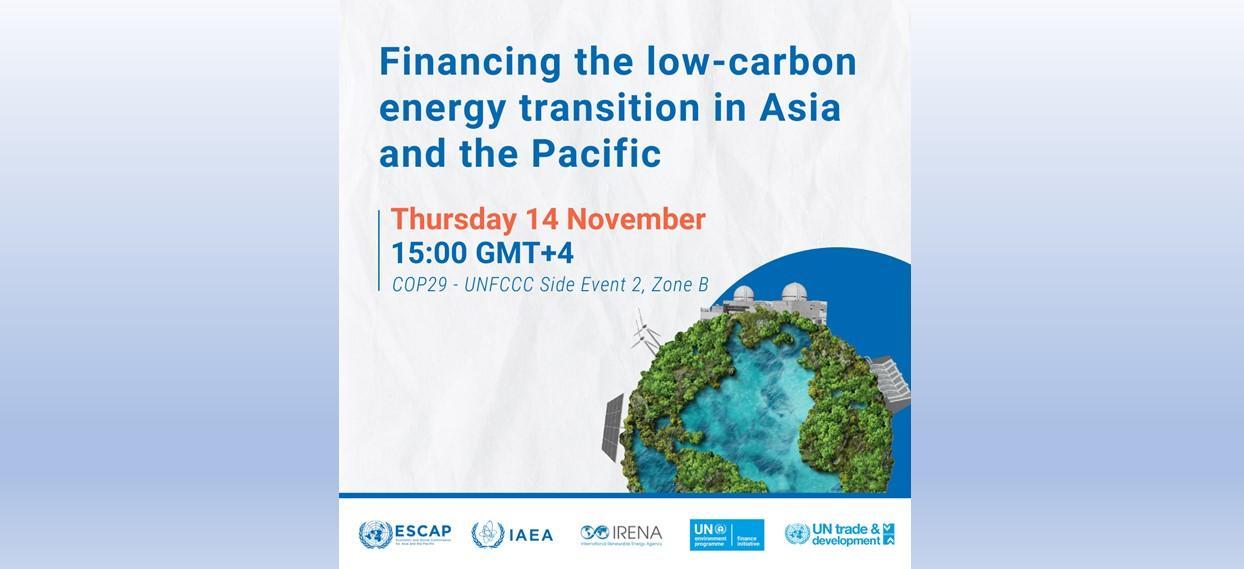
This event will explore options to reconcile these challenges, with speakers from MIC governments, private finance, public development banks, and industry bringing testimonies from the ground. This townhall in-person session seeks to break the “deadlock” that plagues developed and developing states.
This session combines the expertise of UNESCAP, IAEA, UNCTAD, and UNEP-FI as well as IRENA to share insights from best practices related to transition finance, blended finance, and de-risking strategies that aim to sustainably and justly reduce and reallocate risk and reward across a broad range of actors beyond business-as-usual. The discussion will also address root issues such as the complementary role of industrial and procurement policies to help EMDEs gear up for and implement green and low-carbon transformations.
Objectives:
Facilitate a discussion on the need for climate finance to be technology neutral and aligned with national circumstances and priorities of countries in Asia and the Pacific
● Spur discussions and conversations among experts on how MICs should finance the energy transition supporting the phase-out of fossil fuel in coal-dependent countries.
● Explore novel approaches and new partnerships which can mobilize finance and derisk capital-intensive low carbon technologies.
● Identify other innovative solutions in boosting financing, especially for coal-dependent MICs.
