

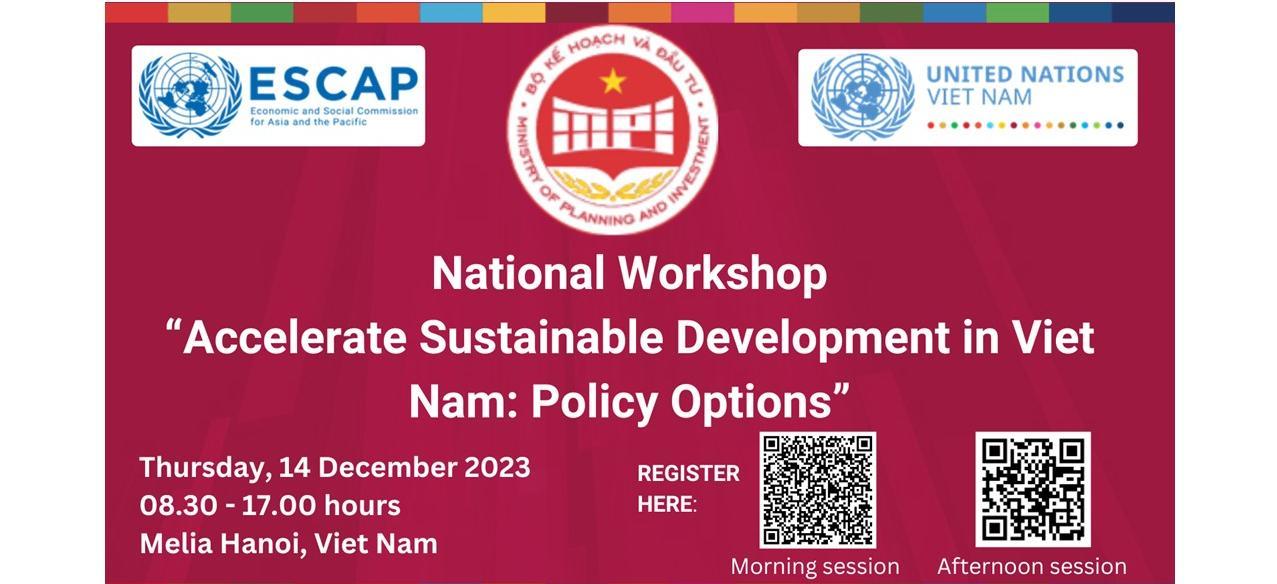
Viet Nam is strongly committed to the 2030 Agenda for Sustainable Development. Whereas, the VNR 2023 reveals that Viet Nam has made significant progress in various Sustainable Development Goals (SDGs), the country needs to expedite the implementation to bring all SDGs back on track to achieve the 2030 targets. In the current context of rising geopolitical contest and economic uncertainty, the country faces more critical development challenges, including building economic resilience, eradicating poverty and inequality and tackling climate risks.
The United Nations Economic and Social Commission for Asia and the Pacific (UNESCAP) and the United Nations in Viet Nam in collaboration with the Ministry of Planning and Investment (MPI) are carrying out a capacity building project that aims to further integrate sustainable development into macroeconomic modelling in Viet Nam. In particular, the model takes an augmented approach to assess public debt sustainability in the long term, which supplements the short- to medium term approaches currently adopted by International Financial Institutions and credit rating agencies The two main outputs are (a) a macroeconomic model that is based on the region-wide ESCAP macroeconomic model, but tailored to Viet Nam’s context; and (b) a national study that examines the socio-economic and environmental implications of selected policy scenarios in Viet Nam. This workshop is organized as part of this project.
Further, the national workshop aimed to:
- foster better understanding of Viet Nam’s development challenges and opportunities, and policy options to help Viet Nam achieve sustainable development targets; and
- improve awareness of the synergies and trade-offs of the implementation of the selected policy options in accelerating the SDG achievement.
For information on the national study, "Accelerate Sustainable Development in Viet Nam: Policy Options", please read it here. The Vietnamese translation is also available.
