Sorry, you need to enable JavaScript to visit this website.
Skip to main content

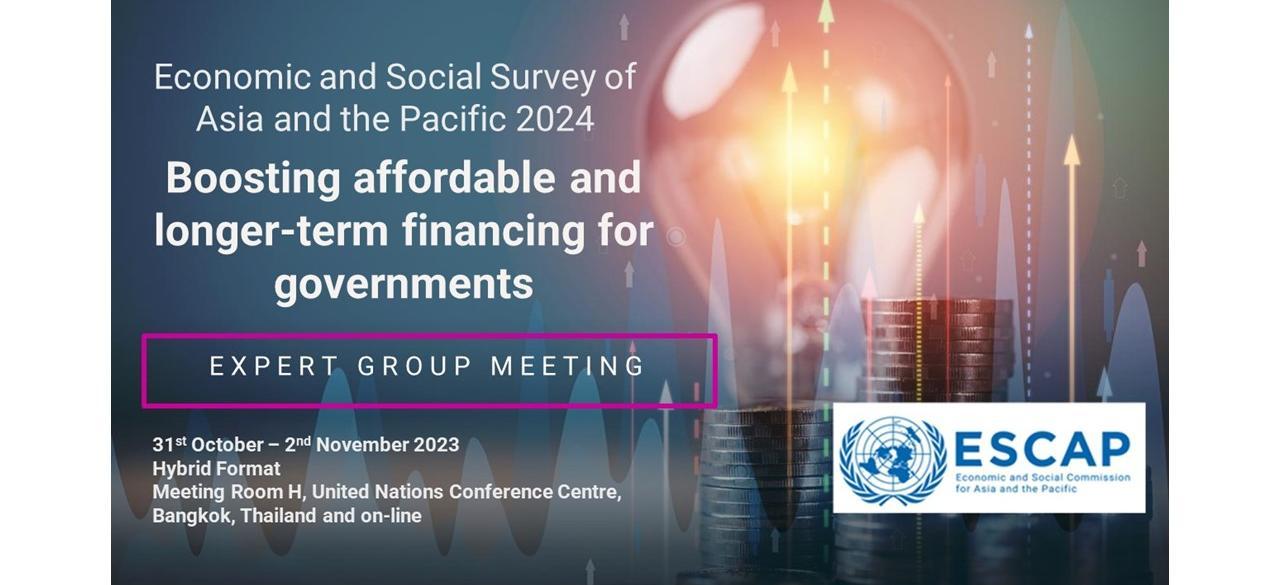
31 Oct to 02 Nov 2023 | Open meeting

Meeting Room-H, United Nations Conference Centre, Bangkok, Thailand and on-line (Hybrid)
Survey2024 EGM

Given the urgency of the SDG Stimulus and that public debt distress is likely to remain a major macroeconomic policy challenge for developing Asia-Pacific countries in coming years, the Survey 2024 will continue to focus on fiscal and public debt challenges. In particular, it will examine a set of policy actions that can be taken by debtor countries in the region and the international community to reduce sovereign borrowing costs and increase the availability of long-term development financing for governments.

This Expert Group Meeting gathered renowned experts, policymakers and stakeholders to discuss these issues and find a way forward. The collective expertise and experience of the participants will be invaluable in developing collaborative and coherent approaches along with impactful policies to ensure affordable and longer-term financing for the governments in developing Asia and the Pacific.

This Expert Group Meeting had two main objectives:

  1. To peer-review draft chapters of the ESCAP flagship publication “Economic and Social Survey of Asia and the Pacific 2024: Boosting affordable and longer-term financing for the governments”.
  2. To engage with experts, policymakers and other development stakeholders on policy options to support governments to finance their SDG investments. 

Contact persons

  • Ms. Lin Zhuo, Economic Affairs Officer, Macroeconomic Policy and Analysis Section (MPAS), Macroeconomic Policy and Financing for Development Division (MPFD); [email protected]


31 Oct 2023
08:00
08:40
Reception Tea and Coffee
Meeting Room H, UNCC, Bangkok
08:40
09:00
Opening Session
Hybrid

Opening remarks (5 mins)

  • Mr. Hamza Ali Malik, Director, Macroeconomic Policy and Financing for Development Division (MPFD), ESCAP


Keynote address (15 mins)

  • Ms. Chutatong Charumilind, ​​​​​Director, Fiscal Policy Research Institute Foundation, Thailand


  • Mr. Aladdin Rillo, Senior Economic Advisor, Institute of ASEAN and East Asia (ERIA), Indonesia


Moderator: Mr. Vatcharin Sirimaneetham, Chief, Macroeconomic Policy and Analysis Section, Macroeconomic Policy and Financing for Development Division (MPFD), ESCAP


09:00
11:00
Session 1 | Increasing affordable and long-term financing: role of effective development cooperation
Hybrid

In view of huge financing needs for SDG investments and a tightening global financing environment, in February 2023, the UN Secretary General outlined an ambitious reform agenda for international development cooperation in his SDG Stimulus to Deliver Agenda 2030. Building on this global agenda, this session initially examined how metrics that go beyond traditional national income levels can be used in transforming the provision and allocation of concessional development financing. It then focused on the role of the two key players --- multilateral development banks and credit rating agencies – in supporting more affordable and longer-term development financing.

Moderator:

  • Mr. Sudyumna Dahal, Regional Public Finance Specialist, UNDP Bangkok Regional Hub


Segment 1 | ESCAP Presentation


Feedback on Chapter 4 draft and presentations


Segment 2 | Experts' Presentations


13:00
15:00
Session 2 | Fiscal policymaking in a changing economic, financial, and development context
Hybrid

The session discusses how some global megatrends are impacting and shaping economies and fiscal policy in Asia and the Pacific. The discussion highlights the key trends of demographic shifts, climate change, technology and digitalization, as well as factors in poverty and inequality. The analysis focuses on the impact channels of these trends on debt and fiscal policy. Furthermore, the discussion will underline key risks for fiscal policies related to the overall increase in macroeconomic uncertainty, rising geo-economic fragmentation, and elevated geopolitical tensions.


The session touched on the assessment of common shortcomings in fiscal policy planning, and fueled discussion on fiscal preparedness towards the changing development environment, with respect to its sustainability, efficiency, and impact on the 2030 Agenda.

Moderator:

  • Ms. Sabine Henning, Chief, Sustainable Demographic Transition Section, Social Development Division, ESCAP

Segment 1 | ESCAP Presentation


Feedback on Chapter 2 draft and Q&A


Segment 2 | Experts' Presentations


01 Nov 2023
12:00
14:00
Session 3 | Macroeconomic prospects, challenges and policies
Hybrid

This session reviewed and discussed the latest macroeconomic developments, expected outlook, and emerging challenges in the Asia-Pacific region for 2023-2024. Policies that can help address these macroeconomic challenges were also discussed.

Moderator:

  • Mr. Ken C. Shawa, Head/Senior Economist, Regional Economic and Social Analysis Unit, ILO Regional Office for Asia and the Pacific

Segment 1 | ESCAP Presentation

  • Macroeconomic prospects, challenges and policies

    • Mr. Shuvojit Banerjee, Economic Affairs Officer, Macroeconomic Policy and Financing for Development Division, ESCAP

    • Ms. Kiatkanid Pongpanich, Senior Researcher, Macroeconomic Policy and Financing for Development Division, ESCAP


Feedback on Chapter 1 draft and Q&A


Segment 2 | Experts' Presentations


02 Nov 2023
07:30
08:00
Reception Tea and Coffee
Meeting Room H, UNCC, Bangkok
08:00
10:00
Session 4 | Increasing affordable and long-term financing: domestic policy actions by debtor countries
Hybrid

Long-term and affordable financing is indispensable for shielding Asia-Pacific countries from debt rollover risks and chronic debt distress and supporting their pursuit of the SDGs. In view of the already heightened debt burdens and potentially higher future borrowing costs, it is an urgent policy issue for Asia-Pacific developing countries to dig deeper into their fiscal potentials and promote domestic supply of long-term and affordable financing. Specific focus will be put on tax potentials of Asia-Pacific developing countries, non-tax public revenue mobilization, boosting domestic savings, and public asset management.

Moderator:

  • Ms. Radhika Lal, SDG Finance Policy Advisor, UNDP, Bangkok

Segment 1 | ESCAP Presentation


Feedback on Chapter 3 draft and Q&A


Segment 2 | Experts' Presentations


  • Infrastructure asset management to unlock financial resources for sustainable development
    • Mr. Daniel Platz, Economic Affairs Officer, UN DESA


  • Leveraging non-tax revenues development financing: the prospect of land value capture
    • Mr. Baoyun Qiao, Dean, China Academy of Public Finance and Public Policy, Central University of Finance and Economics, China


Opening Session

Chutatong Charumilind
Ms. Chutatong Charumilind
Director, Fiscal Policy Research Institute Foundation, Thailand
Know More
Aladdin Rillo
Mr. Aladdin Rillo
Senior Economic Advisor, Institute of ASEAN and East Asia (ERIA), Indonesia
Know More
Hamza Ali Malik
Mr. Hamza Ali Malik
Director, Macroeconomic Policy and Financing for Development Division (MPFD), ESCAP
Know More
Vatcharin Sirimaneetham
Mr. Vatcharin Sirimaneetham
Chief, Macroeconomic Policy and Analysis Section, Macroeconomic Policy and Financing for Development Division (MPFD), ESCAP
Know More

Session 1 | Increasing affordable and long-term financing: role of effective development cooperation

Aleksandr V. Gevorkyan
Mr. Aleksandr V. Gevorkyan
Henry George Chair in Economics and Associate Professor of Economics at the Department of Economics and Finance of the Peter J. Tobin College of Business at St. John’s University
Know More

Aleksandr V. Gevorkyan, Ph.D. is a macroeconomist with research focus on open economy development, economic history, labor migration, diaspora, and post-socialist transition economics. He is the Henry George Chair in Economics and Associate Professor of Economics at the Department of Economics and Finance of the Peter J. Tobin College of Business at St. John’s University in New York City. Dr. Gevorkyan is a Senior Research Fellow at the Vincentian Centre for Church and Society and a Research Fellow at the Center for Global Business Stewardship. He is a member of the Board of Trustees at the Henry George School of Social Science and a Board Member at the Armenian Economic Association. Dr. Gevorkyan also serves as Economics Subject Matter Expert for the Permanent Observer Mission of the Holy See To the United Nations. Dr. Gevorkyan is the author of Transition Economies: Transformation, Development, and Society in Eastern Europe and the Former Soviet Union (Routledge, 2018). For a complete list of publications and ongoing research please see http://agevorkyan.com/

Rodrigo Salvado
Mr. Rodrigo Salvado
Director General, Operational Partnership Department, Asian Infrastructure Investment Bank (AIIB), China
Know More

Salvado manages the Operational Partnership Department, which administers AIIB’s Special Funds resources. He also manages AIIB’s engagement with global and regional coordination mechanisms and partners to build relationships and mobilize additional resources for the Bank’s investment operations. Before joining AIIB in August 2022, he was Deputy Director, International Development Finance for the Bill & Melinda Gates Foundation, where he was in charge of building strategic partnerships and setting up innovative financing mechanisms to mobilize public and private resources toward the Sustainable Development Goals. Previously, he worked for the African Development Bank Group where he was in charge of the Performance Based Allocation System of the African Development Fund and the coordination of the Annual Country Policy and Institutional Assessment. He also worked as a policy analyst for the Center for International Development at Harvard University and as a senior financial officer at the Central American Bank for Economic Integration in Honduras. Rodrigo holds a master’s degree in public administration in International Development from Harvard Kennedy School of Government, a master’s degree in economics from the Centro de Estudios Monetarios y Financieros in Madrid, and a bachelor’s degree of Science in Economics from the Universidad Torcuato Di Tella in Argentina. He is from Italy and Argentina.

Matthew Eldridge
Mr. Matthew Eldridge
Senior Program Officer, Development Policy and Finance, Bill & Melinda Gates Foundation, USA
Know More

Matthew Eldridge is a Senior Program Officer on the Development Policy and Finance team at the Bill & Melinda Gates Foundation. His work focuses primarily on climate finance and mobilizing private capital for development. Prior to joining Gates, he researched and provided technical assistance on innovative financing approaches at the Urban Institute, a think tank. And before that he consulted on financial services regulation and worked at the World Bank. Based in Washington, DC, Matthew earned his BA from Virginia Tech and MSc from the London School of Economics.

Hu Min
Ms. Hu Min
Principal and co-founder, Institute of Global Decarbonization Progress (iGDP)
Know More

Hu Min is the Executive Director of the Innovative Green Growth Partnership(iGDP). She founded iGDP in 2014 and has grown it into a known independent public policy consultancy specializing in climate and clean energy action. Hu Min was the China Advisor and the Head for Access to Cooling at the Kigali Cooling Efficiency Program, a global philanthropic program supporting the transition to clean and efficient cooling technologies. Hu Min also served the Executive President of Beijing Institute of Finance and Sustainability and Program Director for Climate and Environment Management at then Energy Foundation China.

Hu Min has almost 20 years of experience in clean energy and sustainable development policies research and advocacy. Her projects and research cover climate policy, green finance, cooling efficiency, and air quality management. She was involved in efforts to assist China in initiating its carbon market pilots and low carbon economy pilots in 2010. She has published articles and co-edited books on low-carbon cities and environmental governance. Hu Min is the Adjunct Professor for Environmental Policy Design at IE University School of Global Affairs.

Hu received a BA in Economics in 1997, and studied a part-time doctoral program of Environmental Economics both from Renmin University. She did her first MPA from Tsinghua University and a Mid-Career MPA at Harvard Kennedy School, where she is also a Mason fellow. She is now a Senior Fellow at Energy Innovation. In 2014, Hu Min helped launch and served as the first Secretary General of the Green Low Carbon Think Tank Partnership. Hu is a member of World Economy Forum's Global Future Council for Clean Air and a Non-Resident Senor Fellow of Brookings Institute’s Tsinghua Brookings Center.


Sudyumna Dahal
Mr. Sudyumna Dahal
Regional Economist, UNDP Regional Hub for Asia and the Pacific
Know More

Sudyumna Dahal is currently a Regional Economist at the UNDP Regional Hub for Asia and the Pacific, where he covers 36 countries. In this role, he advises on public finance, macroeconomics, environmental finance, and human development in the Asia-Pacific countries under the Hub's purview. He's also one of the lead authors for the upcoming Regional Human Development Report: Making Our Future – New Directions for Human Development in Asia and the Pacific.

With over a decade of professional and academic experience, Sudyumna has worked on international development in various countries, including China, India, Lao PDR, Nepal, Pakistan, Nigeria, Sierra Leone, and the Pacific Island nations. He’s taken on numerous technical and leadership roles, collaborating with governments, development partners, media, and civil society.

Before joining the UNDP, he worked at the World Bank in Washington DC, Africa, and South Asia. Sudyumna authored several flagship reports and has contributed to regional/global knowledge products such as South Asia Economic Focus and Global Economic Prospects of the World Bank.

He holds an MA in International Economics from  Johns Hopkins University (SAIS)  and a PhD from the Centre for Applied Macroeconomic Analysis at the Australian National University (ANU).

Lin Zhuo
Ms. Lin Zhuo
Economic Affairs Officer, Macroeconomic Policy and Financing for Development Division (MPFD), ESCAP
Know More

Session 2 | Fiscal policymaking in a changing economic, financial, and development context

Hiroaki Miyamoto
Mr. Hiroaki Miyamoto
Professor of Economics and Business Administration at Tokyo Metropolitan University
Know More

Hiroaki Miyamoto is a Professor of Economics and Business Administration at Tokyo Metropolitan University. Before joining Tokyo Metropolitan University, he was an economist in Fiscal Affairs Department at the International Monetary Fund. His primary research areas are macroeconomics, labor economics, and the Japanese economy. He has published articles on labor market dynamics, fiscal policies, and the Japanese economy in various leading journals, including Journal of Monetary Economics and Review of Economic Dynamics. His commentary on the Japanese economy also appears in the Wall Street Journal, Bloomberg, East Asia Forum, and Nikkei. He received his Ph.D. in Economics from the University of Wisconsin-Madison.

Mitsuru Katagiri
Mr. Mitsuru Katagiri
Associate Professor, Faculty of Business Administration, Hosei University
Know More

Mitsuru Katagiri is an Associate Professor in the Faculty of Business Administration at Hosei University. He started his career as an economist at the Bank of Japan, followed by a Senior Economist position at the International Monetary Fund. After his return to Japan, he returned to the Bank of Japan as a senior economist, and currently holds an Associate Professor position at Hosei University. He has published multiple papers on aging and its consequences on fiscal policy, monetary policy, and inflation, with a strong focus on Japanese economy.

Sher Singh Verick
Mr. Sher S. Verick
Head, Employment Strategies Unit, Employment Policy Department, ILO
Know More

Sher Singh Verick is Head of the Employment Strategies Unit in the Employment, Labour Market and Youth Branch in the ILO, Geneva. Prior to this position, he was Manager of the Employment Policy and Analysis Programme (EPAP) of the International Training Centre of the ILO and Deputy Director of the ILO Decent Work Team for South Asia and Country Office for India. He has also worked for the United Nations Economic Commission for Africa and various research institutions in Europe and Australia.

Since December 2004, he is a Research Fellow of the Institute for Labor Economics (IZA). Through various roles, he has led and undertaken policy-oriented research and training to promote the formulation and implementation of more effective employment policies. He has published in a range of journals and has authored or edited a number of volumes including, Transformation of Women at Work in Asia: An Unfinished Development Agenda (2016), Perspectives on Labour Economics for Development (2013), and the Labour Markets of Emerging Economies (2013).

He holds a master’s degree in development economics from the Australian National University and a doctorate in economics from the University of Bonn.

Wassana IM-EM
Ms. Wassana Im-em
Technical Specialist on Population Development, UNFPA
Know More

Wassana IM-EM is a Technical Specialist on Population Development at the UNFPA Asia and Pacific Regional Office. She was previously the Head of Office of UNFPA Thailand. She was an active member of the United Nations Country Team in Thailand, and co-chaired the United Nations Sub-group on young people with UNICEF and the United Nations Sub-Group on gender-based violence with UN Women. She led and managed the UNFPA Country Programme in Thailand as Assistant Representative from 2006 to 2019. While working in Thailand she supported the Government to implement the International Conference on Population and Development (ICPD) Programme of Actions within the framework of the Sustainable Development Goals (SDGs) which included the formulation and implementation of - the Prevention and Alleviation of Adolescent Pregnancy Act; the National Reproductive Health Policy; the National Condom Policy; as well as the 20-years Population Policy. Her strength is on using socio-demographic evidence to support policy development through a life-course.

Wassana received a PhD in population studies from The Australian National University in 1996, and was the Population Council Postdoctoral at the Center for Studies in Demography and Ecology of University of Washington from 2000-2004. She was Associate Professor in demography affiliated with the Institute for Population and Social Research of Mahidol University from 1996-2005 in which she was Director of the international master’s degree programme on sexual and reproductive health and social research before joining UNFPA.

 Sabine Henning
Ms. Sabine Henning
Chief, Sustainable Demographic Transition Section, Social Development Division, ESCAP
Know More

Sabine Henning is the Chief of the Sustainable Demographic Transition Section, Social Development Division, United Nations Economic and Social Commission for Asia and the Pacific (UN-ESCAP), Bangkok, Thailand. Since 2018, she has led work on population and development issues at UNESCAP, focusing on research, capacity-building, and intergovernmental support on population dynamics, ageing, migration, and youth.

From 2015-2018, Ms. Henning was Senior Population Affairs Officer and Chief, Office of the Director, Population Division, Department of Economic and Social Affairs (UN-DESA), United Nations, New York, advising the Director, overseeing personnel and programme management, and serving as focal point for annual sessions of the Commission on Population and Development. From 2000 to 2015, she served successively in the Population Division’s Population Estimates and Projections Section, the Population and Development Section, the Migration Section, and the Population Policy Section. For over 20 years and serving at UN Headquarters and ESCAP, she has been involved in UN interagency work and coordination, co-authored United Nations reports, including the recently published Asia-Pacific Migration Report 2020 and several UN-DESA flagship publications and serviced numerous intergovernmental meetings and high-level events on population, migration, and development issues. She has also published in peer-reviewed journals.

Ms. Henning has a Ph.D. in Geography with a doctoral-level certificate in Demography from the University of Colorado at Boulder, and a graduate-level certificate in Strategic Management from Harvard University.

Michal Podolski
Mr. Michał Podolski
Associate Economic Affairs Officer, Macroeconomic Policy and Financing for Development Division (MPFD), ESCAP
Know More

Session 3 | Macroeconomic prospects, challenges and policies

Melissa Langworthy
Ms. Melissa Langworthy
ESCAP Consultant and Economist on Gender and Sustainability
Know More

Dr. Melissa Langworthy is a feminist economist specializing in inclusive and sustainable growth, political economy, and gender equality. She has over 15 years of experience working on economic justice, labor rights, and social protection; and gender mainstreaming and capacity building for government, NGO, and private sector actors, including Facebook, UN Women, Oxfam, and the European Union. Her regional expertise is in MENA and Asia and the Pacific, with a focus on evolving social and economic ecosystems in the Gulf states. Dr. Langworthy has provided technical leadership for academic institutions, community-based organizations, and the private sector to design and implement successful initiatives, to prioritize gender in policy and advocacy efforts, and to advocate for evidence-based policymaking.

Jules Hugot
Mr. Jules Hugot
Economist, Macroeconomics Research Division, Economic Research and Development Impact Department, ADB
Know More

Jules Hugot is an economist with the Asian Development Bank, based in Bishkek, Kyrgyzstan. He contributes to ADB’s macroeconomic monitoring work, covering (i) trade, global value chains, tourism, and remittances, and (ii) growth and inflation outlook across Asia, as well as (iii) the Caucasus and Central Asia at large. His research relies on gravity models to explore the impact of trade policy and infrastructure on trade and value chains. He holds a PhD from Sciences Po, and prior to joining ADB was a lecturer Université La Sorbonne in Paris and an Assistant Professor at Universidad Javeriana in Bogotá. Since he joined ADB, he has also worked on agriculture value chain development, notably processing private-sector projects.


Allen Ng
Mr. Allen Ng
Group Head and Principal Economist, Regional Surveillance group, ASEAN+3 Macroeconomic Research Office (AMRO)
Know More

Mr. Allen Ng leads the Regional Surveillance group, which is responsible for the annual ASEAN+3 Regional Economic Outlook and related updates. He also leads a team of economists in conducting macroeconomic and financial system surveillance on Thailand.

Previously, he served as the Chief Economist of Securities Commission Malaysia (SCM), where he oversaw the overall macroeconomic surveillance and research work of the SCM. He was also a member of the International Organization of Securities Commissions’ (IOSCO) Committee on Emerging Risks and a member of the board of directors of the Institute for Capital Market Research Malaysia (ICMR), an independent think-tank established by the SCM.

Before joining the SCM, Mr. Ng was Director of Research at Khazanah Research Institute, a think-tank affiliated with Malaysia’s sovereign wealth fund.

Prior to that, he spent more than a decade in Bank Negara Malaysia, serving in various roles over the years. His most recent position at the central bank was Deputy Director of the Monetary Policy Department, where he was primarily responsible for leading macroeconomic surveillance and research on matters relating to money and credit, as well as overseeing the secretariat function of the central bank’s Monetary Policy Committee. He also served as the Deputy Director of the Economics Department where he was responsible for, among other duties, overseeing long-term structural policy research to support the central bank’s economic advisory role to the Malaysian government.

Mr. Ng has a BA and an MPhil in Economics from the University of Cambridge.

Hasan Muhammad Mohsin
Mr. Hasan Muhammad Mohsin
Chief of Macroeconomic Section, Ministry of Planning, Development and Special Initiatives, Pakistan
Know More

Dr Hasan M Mohsin is presently posted as Chief Macroeconomics Section in the Ministry of Planning, Development and Special Initiatives, Pakistan. He joined government economist group service in 2018 as Chief and served various positions including Chief International Trade, Plan Coordination and Joint Economic Advisor in the Ministry of Finance.

Before 2018, he worked as Senior Research Economist and Head of Economics and Finance Department at Pakistan Institute of Development Economics, a premier think tank under the administrative control of Ministry of Planning, Development and Special Initiative. He published research articles in the field of Applied Monetary and Macroeconomics and also supervised M.Phil and doctoral research.

He completed his PhD Economics from Southern Illinois University Carbondale, USA specializing in Macroeconomics and Monetary and Financial Economics as a Fulbright scholar. He did his Masters in Financial and Industrial Economics from Royal Holloway University of London, funded by British Chevening scholarship. Prior to that he did his Masters and M.Phil in Economics from Quaid-i-Azam University Islamabad.

Kensuke Molnar-Tanaka
Mr. Kensuke Molnar-Tanaka
Head of Asia Desk, OECD Development Centre
Know More

Kensuke Molnar-Tanaka is the Head of the Asia Desk at the OECD Development Centre in France, leading a team to produce thematic, region-specific analysis on development, public policy and disasters in Asia.


He initiated and is in charge of various regular OECD products, such as the flagship publication OECD Economic Outlook for Southeast Asia, China and India since 2010, OECD Revenue Statistics in Asian and Pacific Economies since 2014, and This Quarter in Asia (2010-13). He constructed the Medium-term Projection Framework to serve the forecasts for the regional economic outlook.


He is the lead author of approximately 40 books in the areas of development and economic outlook, public policies such as macroeconomic, finance and fiscal policy, disaster risk reduction, infrastructure development, and peer review mechanism.


In addition, he established the annual OECD-AMRO-ADB-ADBI-ERIA Asian Regional Roundtable on Macroeconomic and Structural Policies from 2012, and Asia Regional Expert Meeting on Development, Disasters and Catastrophes (Am-DC) from 2023 for strengthening policy dialogue in the region. 


Previously, he was a Programme Manager on Southeast Asia, at CCNM, OECD and taught at Sciences Po, France and held lectures at various universities in Asia.

Ken C. Shawa
Mr. Ken C. Shawa
Head/Senior Economist, Regional Economic and Social Analysis Unit, ILO Regional Office for Asia and the Pacific
Know More

Ken Shawa is a Senior Economist and Head of the Regional Economic and Social Analysis Unit (RESA) at the ILO's Regional Office for Asia and the Pacific, Bangkok, Thailand, and a member of the ILO’s Research Department. He coordinates ILO’s research work and leads the analytical work of the region. Prior to joining the ILO, he worked in the academia, at COMESA and the African Union (AU). He holds a PhD in Economics, an MSc in International Environmental Management, and a Master of Arts in Economics. He is also a fellow of Health Economics and Policy at the University of Lancaster, UK.

Shuvojit Banerjee
Mr. Shuvojit Banerjee
Economic Affairs Officer, Macroeconomic Policy and Financing for Development Division (MPFD), ESCAP
Know More
Kiatkanid Pongpanich
Ms. Kiatkanid Pongpanich
enior Researcher, Macroeconomic Policy and Financing for Development Division (MPFD), ESCAP
Know More

Session 4 | Increasing affordable and long-term financing: domestic policy actions by debtor countries

Sanjeev Gupta
Mr. Sanjeev Gupta
Senior Fellow Emeritus, Center for the Global Development and Senior Fellow, African Center for Economic Transformation
Know More

Sanjeev Gupta is Senior Fellow Emeritus at the Center for the Global Development and a Senior Fellow at the African Center for Economic Transformation. He was previously a Deputy Director at the Fiscal Affairs Department of the International Monetary Fund (IMF), where he also worked in its African and European Departments. During 2013/2014, he was the acting Director of the Fiscal Affairs Department. Mr. Gupta has authored/coauthored over 150 papers on macroeconomic and fiscal issues covering advanced, emerging and low-income countries, many published in well-known academic journals and authored/coauthored/co-edited thirteen books.

Daniel Platz
Mr. Daniel Platz
Economic Affairs Officer, UN DESA
Know More

Daniel Platz has been with the United Nations for 20 years and is currently Senior Economic Affairs Officer, Department of Social and Economic Affairs. He was a leader for the UN Handbook on Economics and Asset Management and has helped establish infrastructure asset management training for countries in Africa, Southeast Asia, and Central America. Mr. Platz has a PhD in Economics and his research interest and expertise covers municipal finance, infrastructure finance and financial inclusion.

Baoyun Qiao
Mr. Baoyun Qiao
Dean, China Academy of Public Finance and Public Policy, Central University of Finance and Economics, China
Know More

Baoyun Qiao is Professor of economics and Dean of China Academy of Public Finance and Policy. He has directed multiple fiscal reform projects in China. He has advised to China’s Ministry of Finance on fiscal decentralization, subnational debt management, performance budgeting, intergovernmental fiscal relation, among others. Prof. Qiao also worked with many governments as well as international organizations such as ADB, the World Bank on public finance.

Joseph Stead
Mr. Joseph Stead
Senior Policy Analyst, Global Relations and Development, OECD
Know More

Joseph Stead is a Senior Policy Analyst on Tax and Development in the OECD Centre for Tax Policy and Administration. He leads the OECD work on tax morale, focusing on what drives voluntary compliance in developing countries. He also works on the role of development cooperation in improving tax policy and administration in developing countries, including co-ordinating the OECD’s tax capacity building programme. Prior to joining the OECD, Joseph worked at the NGO Christian Aid as well as in the UK Civil Service, and was also the co-chair of the board of the Jubilee Debt Campaign.

Radhika Lal
Ms. Radhika Lal
SDG Finance Policy Advisor, UNDP, Bangkok
Know More

Radhika Lal is currently SDG Finance Policy Advisor based in UNDP's regional hub in Bangkok, and has held various senior advisor and coordinator positions within UNDP around the globe. She is a political economist by training and is both passionate and practical about development, connecting the dots and working collaboratively.

Zheng Jian
Mr. Zheng Jian
Economic Affairs Officer, Macroeconomic Policy and Financing for Development Division (MPFD), ESCAP
Know More

for more information, please contact

Macroeconomic Policy and Financing for Development Division +66 2 288-1234 [email protected]

Print this page