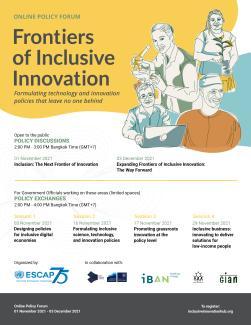
The United Nations Economic and Social Commission for Asia and the Pacific (ESCAP), in collaboration with Digital Pathways at Oxford, the Inclusive Business Action Network (iBAN), the Honey Bee Network, and the Gujarat Grassroots Innovations Augmentation Network (GIAN), organised a Forum on Frontiers of Inclusive Innovation: Formulating Technology and Innovation Policies that Leave No one Behind. The forum took place through a series of six online sessions in November and December 2021.
The full report, Frontiers of inclusive innovation: Formulating technology and innovation policies that leave no one behind, is available here.
The third policy exchange focused on promoting grassroots innovation at the policy level. It presented experiences of promoting grassroots innovations in India, Malaysia, and the Philippines. It also explored how to support more inclusive processes and outcomes in this field.
Key Messages
Innovation policies must go beyond promoting entrepreneurship and start-ups, and encourage grassroots innovations and innovation in the public sector. It is important that policymakers understand grassroots innovations so that policies can give these initiatives an opportunity to create impact at the local and national levels.
- Bring grassroots innovations into mainstream discussions in national and global spaces to help link grassroots innovations to resources. Developing a larger platform for existing grassroots innovators to share their projects may spark curiosity in others and help give grassroots innovators access to networks and resources.
- Grassroots innovations should be included in national innovation ecosystems to be sustainable. Grassroots innovations operate with limited resources and are highly vulnerable to shocks. Ensuring linkages between these innovators and the formal innovation ecosystem would help increase support, resources, and recognition.
- Localised and community-based grassroots innovations should not be standardised. Funding and support for grassroots innovators should respect the processes and perspectives of grassroots innovators. For instance, it should not pressure grassroots innovators into developing high-quality standardised products, as these may not be relevant to address local needs with local resources.
Examples of good practices
- India’s the Promoting innovations in Individuals, Startups and MSMEs (PRISM) scheme seeks to support individuals to translate their ideas from concept to prototype no matter their level of literacy or knowledge of English. A multi-language database has also been created by the Honey Bee Network to showcase grassroots innovations.
- The Department of Science and Technology in the Philippines has formulated the Grassroots Innovation for Inclusive Development (GRIND) Framework Plan 2019–2022 to promote grassroots innovations based on four pillars: learning, leveraging, linking and legitimising. It aims to develop communities of practice that are resilient and agile in addressing economic and environmental stresses relying on their local resources.
- Supported by the Department of Science Technology, Malaysia has drafted the Social Innovation Policy which aims to create larger spaces for community innovation centres. A new program has also been developed to identify and support dying arts.
Moving Forward
Steps to appropriately recognize and position grassroots innovations within national innovation policies and innovation frameworks are required. This will enable the development of linkages between grassroots innovators and the formal innovation system and a more consistent and coherent support for grassroots innovators. Innovation groups and policymakers could also look into opportunities for creating a country or global fund to further harness the potential of grassroots innovations.
|
We must also demonstrate that even without help from policymakers, they [grassroots innovators] will have done something. [...] If they could get help from the government, they can do much more.” Prof. Anil K. Gupta, Founder and Coordinator, Honey Bee Network |
|
Message from Prof. Anil K. Gupta on "why is it important to promote grassroots innovations?":