Sorry, you need to enable JavaScript to visit this website.
Skip to main content

16 Nov 2021 | By invitation only

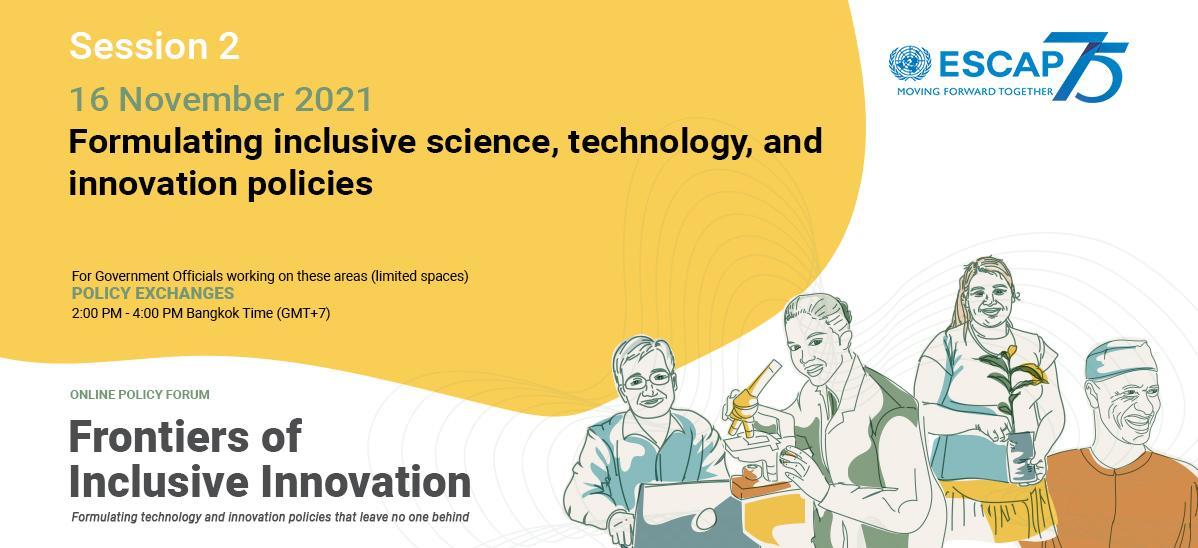
Expert Group Meeting on Formulating Inclusive Science, Technology and Innovation Policies

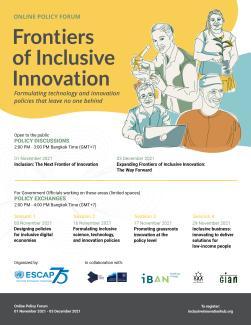
The United Nations Economic and Social Commission for Asia and the Pacific (ESCAP), in collaboration with Digital Pathways at Oxford, the Inclusive Business Action Network (iBAN), the Honey Bee Network, and the Gujarat Grassroots Innovations Augmentation Network (GIAN), organised a Forum on Frontiers of Inclusive Innovation: Formulating Technology and Innovation Policies that Leave No one Behind. The forum took place through a series of six online sessions in November and December 2021.  

The second policy exchange discussed how different countries are formulating inclusive science, technology, and innovation (STI) policies. It highlighted the various dimensions of inclusive STI policies and how to design for inclusion.

The full report, Frontiers of inclusive innovation: Formulating technology and innovation policies that leave no one behind, is available here.


Key Messages

Formulating inclusive STI policies is essential to shift from a perspective that centres on economic gains to one that also aims to bring social and environmental benefits. Only inclusive innovation policy is good innovation policy because inclusiveness is good for long term development both economic and social, promotes fairness and equality and broadens the talent base. 

  1. Ensure inclusivity by institutionalising multi-sectoral policy-making processes. An inclusive STI policy starts with having an inclusive STI policy-making process. An inclusive STI policy making process engages women, indigenous groups, the youth, and other marginalised communities. It also includes a wider range of public organisations (from ministerial departments to local administration) as well as representatives from academia, grassroots innovators, social enterprises, local start-ups, civil society organisations, media, international development organisations, and the private sector.
  2. Bring innovation closer to the people. There are many opportunities to bring innovation closer to the people. From building innovation hubs at provincial and regional levels, especially in poorer areas to partnering with local and research-oriented universities, private sector, and civil society organisations in building the capacities of local innovators. Promoting science, technology, arts, and mathematics (STEAM) in schools remains essential to harness the skills of future innovators.  Media and social media platforms can help build community awareness on innovative practises relevant for their communities.
  3. Accountability of the innovation ecosystem must be ensured through monitoring and evaluation mechanisms. To be inclusive it is essential to track outcomes of innovation policies to ensure that the target communities and groups have reaped economic, social, and environmental gains from them. Establishing specific inclusion targets and indicators, and regularly collecting and reporting disaggregated data is essential to measure inclusivity and enhance accountability.
     

Examples of good practices

  • In the Philippines, the Philippine Innovation Act was approved in 2019 to harness innovation efforts to help the poor and marginalised, women, and to enable MSMEs to be part of the domestic and global supply chains. The Act also includes specific provisions to support the innovation of indigenous cultural communities, for them to preserve and make sustainable use of traditional knowledge. One of the achievements of this law is the consolidation of innovation efforts of the government in one platform, the national innovation agenda, and sustainable plan.
  • In Thailand, the Social Innovation Driving unit of the National Innovation Agency selects community-based and local-oriented provincial universities to partner on developing social innovation projects.
     

Moving forward

To effectively promote inclusive technology and innovation it is essential to ensure sustainable funding is not just from the government budget but also from the private sector, including from corporations and impact investors. Hence, there is an opportunity to include impact investors and venture capitalists in future policy discussions on STI.

“We want to explore how governments across this region are formulating inclusive science, technology and innovation policies that go beyond seeking increases in productivity and economic growth [...] we want to make sure that we also see social benefits.”

Marta Pérez Cusó, Economic Affairs Officer, United Nations ESCAP


Message from Mr. Geert van der Veen (Managing Partner, Technopolis Group Amsterdam) on "how can we expand the frontiers of inclusive innovation to ensure that we leave no one behind?":


Dr. Anthony Sales, Regional Director, Department of Science and Technology (Region XI), Philippines
Dr. Anthony Sales
Regional Director, Department of Science and Technology (Region XI), Philippines
Know More

Dr. Anthony C. Sales is Dr. Anthony C. Sales is a Food Technologist by profession, a researcher, and a public servant. Currently, he is the Regional Director in the Philippine Department of Science and Technology (Region XI).

Dr. Sales was the first DOST Regional Director to become a member of the National Research Council of the Philippines and now leads the implementation of the project Frontier Research Agenda and Capability Building of Researchers in Mindanao I:  NRCP Science and Technology Expert’s Pool (NSTEP). He has spearheaded efforts to gain Level 1 and Level 2 recognition for DOST XI under the Philippine Quality Award, a national award for Total Quality Management equivalent to the Malcolm Baldridge Award in the United States. He also leads the implementation of the DOST Halal S&T Program and the Grassroots Innovation for Inclusive Development or GRIND Program. He was recently appointed as the Chair of the Professional Regulatory Board of Food Technology. 

Mr. Geert van der Veen, Managing Partner, Technopolis Group Amsterdam
Mr. Geert van der Veen
Managing Partner, Technopolis Group Amsterdam
Know More

Geert van der Veen is managing Partner of Technopolis Group in Amsterdam and member of the Company Board of Technopolis Group. Technopolis is one of the leading consulting companies in the world on science, innovation and entrepreneurship policy. Important areas of interest are Green Economy, Health, Higher Education, New technologies and International cooperation. 

Geert was educated as  an environmental engineer and has some 30 years of experience a researcher, a civil servant at a government agency, a director of a research institute and a consultant. He mainly works on strategy formulation and evaluation, often related to research institutes and or green economy. 

Recent flagship projects led by Geert are, amongst others, the  evaluation of the six national research institutes in The Netherlands (“TO2-instituten”, 2021), the development of a national STI strategy for Myanmar (2020), the evaluation of the 3 national research institutes in Luxembourg (2019) and the support for the development of the strategy of Dutch research council NWO (2018). Furthermore, he was involved in various studies for the European Commission (e.g. the ex-ante impact assessment of the Institutionalised Partnerships (2020).

Dr. Pun-Arj Chairatana, Executive Director, National Innovation Agency, Government of Thailand
Dr. Pun-Arj Chairatana
Executive Director, National Innovation Agency, Government of Thailand
Know More

Dr. Pun-Arj Chairatana is a science, technology, and innovation policy maker with substantial international and national experience. In his career he has kept his focus on new economy, emerging technologies, poverty and innovation, innovator and corporate innovation, technology assessment and evaluation, and STI strategies and R&D management. Dr. Chairatana is also Startup Thailand ecosystem builder.

Ms. Marta Perez Cuso, Economic Affairs Officer, Trade, Investment and Innovation Division, United Nations ESCAP
Marta Pérez Cusó
Economic Affairs Officer, Trade, Investment and Innovation Division, United Nations ESCAP
Know More

Marta Pérez Cusó leads ESCAP’s programme on inclusive technology and innovation policies to promote technologies and innovations that leave no one behind. She also leads ESCAP’s work on promoting enabling policy environments for inclusive business in ASEAN.

She has over 18 years’ work experience with the United Nations providing policy advice on science, technology and innovation (STI) and information and communication technology policies to governments across Asia and Latin America.

Before joining ESCAP, Ms. Pérez Cusó worked with UNCTAD and Oxfam GB. She holds an MSc in Development Management, Open University UK and is fluent in Spanish, English, French and Catalan.

Mr. Rafael Torquato Cruz, Community Manager, Innovation, Enterprise and Investment Section, Trade, Investment and Innovation Division, United Nations ESCAP
Rafael Torquato Cruz
Community Manager, Community of Practice on AI (COPAI), Innovation, Enterprise and Investment Section, Trade, Investment and Innovation Division, United Nations ESCAP
Know More

Rafael Torquato Cruz is a Project Coordinator and Community Manager at the United Nations Economic and Social Commission for Asia and the Pacific (ESCAP), where he leads the Community of Practice on Artificial Intelligence (COPAI) within the Innovation, Enterprise and Investment Section. His work focuses on advancing inclusive and sustainable science, technology, and innovation (STI) policies across the Asia-Pacific region.

Rafael has directly supported policymakers in co-developing national STI strategies, including Myanmar’s National STI Policy, Cambodia’s STI Roadmap 2030 and National Research Agenda. He co-authored ESCAP’s 2024 policy workbook on private sector engagement in STI, emphasizing startup growth and human capital development in Cambodia, Lao PDR, Thailand, and Viet Nam (CLTV).

Under his leadership, COPAI promotes ethical, inclusive, and culturally grounded AI research and innovation, including the “Generous AI” principles, which integrates Buddhist values into AI Ethics. Rafael has also moderated regional dialogues on generative AI and inclusive innovation, such as the webinar on the future of generative AI in Asia and the Pacific.

He holds a master’s degree in political science and international relations.

for more information, please contact

Trade, Investment and Innovation Division +66 2 288-1234 [email protected]
Print this page