Sorry, you need to enable JavaScript to visit this website.
Skip to main content

03 Nov 2021 | By invitation only

Innovation forum

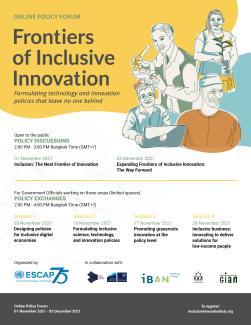
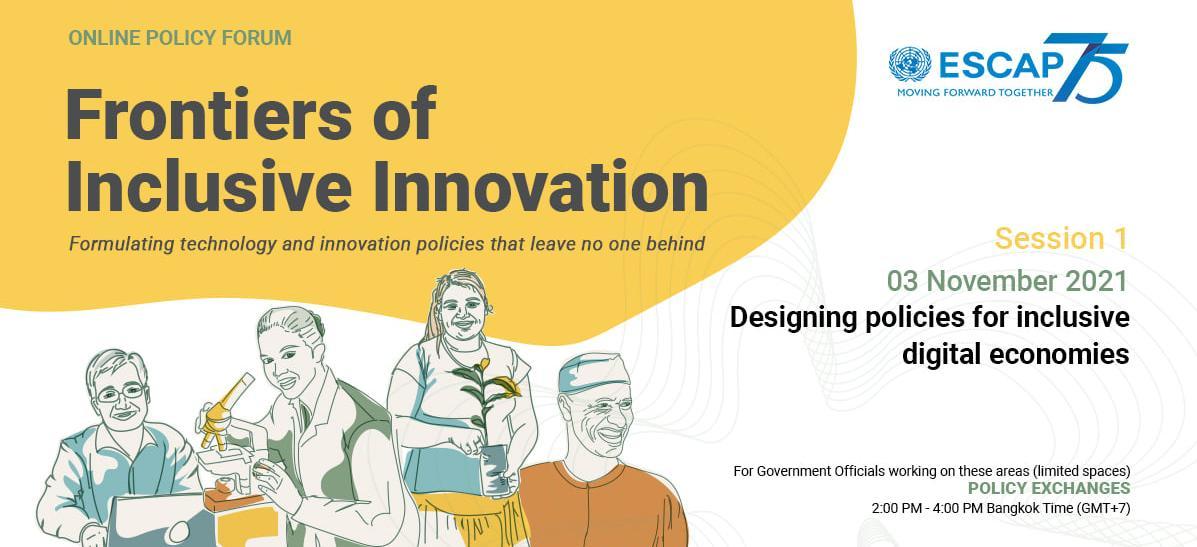
The United Nations Economic and Social Commission for Asia and the Pacific (ESCAP), in collaboration with Digital Pathways at Oxford, the Inclusive Business Action Network (iBAN), the Honey Bee Network, and the Gujarat Grassroots Innovations Augmentation Network (GIAN), organised a Forum on Frontiers of Inclusive Innovation: Formulating Technology and Innovation Policies that Leave No one Behind. The forum took place through a series of six online sessions in November and December 2021.  

This first policy exchange emphasized the importance of introducing inclusive dimensions in the process of formulating digital economy strategies. It also identified challenges and opportunities that governments face in promoting these strategies.

The full report, Frontiers of inclusive innovation: Formulating technology and innovation policies that leave no one behind, is available here.


Key Messages

Beyond just guaranteeing that policies and regulatory metrics and frameworks cover women and the youth, policymakers must consider the systemic challenges marginalised groups face when accessing digital innovations. Digitalisation – of processes for instance – can often create difficulties for people who are excluded. As one participant policymaker pointed out, “[The] pandemic actually showed us [...] very stark examples of how we have excluded a lot of people because we did not pay attention. So, policy choices are changing to make deliberate decisions on inclusion.” 

  1. Metrics and frameworks to measure and promote the inclusiveness of the digital economy are welcome but need refinement. Standardised tools to measure digital inclusion such as the UNCDF’s Inclusive Digital Economy Scorecard are very valuable to provide guidance and remove subjectivity on promoting inclusion. Yet, further information and interpretation would be needed to ensure that the indicators are relevant to various stakeholders in different countries.
  2. Data collection processes that inform digital inclusion policy making need to be representative. The fact that those excluded from the digital economy do not provide digital data must be considered to avoid widening the digital divide. Digital (real-time data from telecommunication groups and other data providers) and traditional (focus group discussions and surveys) methods can complement each other to ensure inclusive data collection processes.
  3. An intersectoral approach to digital inclusion requires buy-in from all stakeholders. This is especially true regarding incumbents who have until now benefited from the older, non-digital norms. To promote buy-in, stakeholders have used data and other analytics to build a case for why digital inclusion is a necessary step and have formed coalitions with various agencies.
     

Examples of good practices

  • Bangladesh set up digital centres in rural areas and has developed a unique public-private partnership model operated by entrepreneurs connecting citizens to ICT services.
  • In the Philippines, the newly enacted Philippine Innovation Act mandates a whole-of-government approach to addressing lack of access to digital technologies. This will enable the government to promote innovation from a broader perspective and to enable solutions relevant to the local context.
  • Indonesia has launched the Digital Talent Scholarship to increase productivity in the digital ecosystem, which aims to benefit 400,000 students per year: and the Digital Leadership Academy Program for those in senior positions in the public and private industries. Partnerships with different prestigious universities have been made to give local leaders access to training.
     

Moving forward

A participatory and multi-stakeholder process in formulating an encompassing framework for digital inclusion would enhance the inclusive dimension of digital policies, increase representation from excluded sectors, and expand incentives for different agencies and stakeholders to engage.

“The world is becoming digital [...] if you're not making a deliberate choice, design choice, policy choice to include the otherwise excluded, then they will be left out. “

Anir Chowdhury, Policy Advisor, UNDP/Government of Bangladesh


Message from Ms. Elizabeth Stuart on "what are some of the opportunities to promote inclusive digital economy strategies?":


Ms. Maria Perdomo, Regional Manager for Asia - Inclusive Digital Economies at UNCDF
Ms. Maria Perdomo
Regional Manager for Asia - Inclusive Digital Economies at UNCDF
Know More

Maria Perdomo is the Regional Manager for Asia, Inclusive Digital Economies and Regional Coordinator for Asia at the UN Capital Development Fund (UNCDF) in Thailand. She has spent the past 15 years focused on removing market constraints to advance financial inclusion in developing countries and emerging markets. As a Regional Manager of the UNCDF Inclusive Digital Economies practice area for Asia, she provides strategic vision and technical support to develop inclusive digital economies that can unlock private finance for all and support the achievement of the SDGs in the region. In her previous role as a Youth Finance Lead, she brought access to financial services for close to 1,000,000 youth of which 60 per cent were young women and girls. Her portfolio grew from 8 to 13 countries, and from US$12 to US$20 million from 2015 to 2020. She enjoys building and leading innovative strategies and partnerships to reduce the gender gap and to address the obstacles to achieve young women and girls economic empowerment. She has worked with policy makers, banks, mobile money operators, fintechs, developers of digital solutions, youth serving organizations and NGOs across Africa, Asia and Latin America. She has a Master’s degree in International Affairs and Economic Development from Columbia University, and a Bachelor’s Degree from Externado de Colombia University and l’Institut de Sciences Politiques de Paris (Sciences-Po).

Mr. Anir Chowdhury, Policy Advisor at UNDP/Government of Bangladesh
Mr. Anir Chowdhury
Policy Advisor at UNDP/Government of Bangladesh
Know More

Anir Chowdhury is a Programme Advisor of the a2i Programme of the ICT Division and the Cabinet Division of the Government of Bangladesh supported by the UNDP. He leads the formation of a whole-of-society innovation ecosystem in Bangladesh through massive technology deployment, extensive capacity development, integrated policy formulation, whole-of-government institutional reform, and an Innovation Fund. His work on innovation in public service has developed interesting and replicable models of service delivery decentralization, public-private partnerships, and transformation of a traditional bureaucracy into a forward-looking, citizen-centric service provider. He is a regular speaker in international conferences on public service innovation and reform, digital financial inclusion, civil registration and digital identity management, SDGs, youth and community empowerment, educational transformation, public-private partnerships, and South-South Cooperation. He is a member of the Prime Minister’s National Digital Task Force, Education Minister’s National ICT in Education Task Force, UNESCAP Regional Steering Group for Civil Registration and Vital Statistics (CRVS), Co-Founder and Board Member of South-South Network for Public Service Innovation (SSN4PSI) and Co-Founder of South-Asia Civil Registration Network (CR8). He co-founded several software and service companies and non-profit organizations in the US and Bangladesh. He graduated magna cum laude in Computer Science and Applied Mathematics from Brown University and did post-graduate work on management, marketing, and education reform in Harvard, Columbia, and Boston Universities.

Mr. Tengis Sukhee, Head of Secretariat of the National Digital Development Committee of the Mongolian Government
Mr. Tengis Sukhee
Head of Secretariat of the National Digital Development Committee of the Mongolian Government
Know More

Tengis Sukhee is the Head of Secretariat of the National Digital Development Committee of the Mongolian Government. An experienced Information Security Consultant with a demonstrated history of working in the telecommunications industry, Tengis is skilled in 3G, Business Planning, Enterprise Software, Revenue Assurance, and Business Support System (BSS). He also has experience in information technology with a Bachelor’s degree focused in Software Engineering from the Computer Science and Management School of the Mongolian University of Science and Technology.

Ms. Elizabeth Stuart, Executive Director at Digital Pathways at Oxford
Ms. Elizabeth Stuart
Executive Director at Digital Pathways at Oxford
Know More

Elizabeth Stuart is the Executive Director of Digital Pathways at Oxford and previously performed the same role for the Pathways for Prosperity Commission, which was co-chaired by philanthropist Melinda Gates, tech entrepreneur Strive Masiyiwa and Indonesian finance minister Sri Mulyani Indrawati. Before joining the Blavatnik School of Government, she was the director of growth, poverty and inequality at the Overseas Development Institute (ODI); director of policy and research for Save the Children UK; and spent seven years in Washington DC running the Oxfam International office. She was formerly a financial journalist for the Guardian newspaper and the BBC. She also has an undergraduate degree in modern languages, and masters degrees in literature and politics.

Mr. Jonathan Wong, Chief, Technology and Innovation Section, ESCAP
Mr. Jonathan Wong
Chief, Technology and Innovation Section, ESCAP
Know More

Jonathan Wong is the Chief of Technology and Innovation at the United Nations Economic and Social Commission for Asia and the Pacific (ESCAP). He joined ESCAP from the UK Department for International Development (DFID), where he was the inaugural Head of Innovation. He has led the establishment of several high-profile innovation initiatives including the Global Innovation Fund, a partnership between the Omidyar Network and the governments of the US, UK, Sweden, Australia and South Africa. Jonathan has extensive experience in social innovation and entrepreneurship, innovative financing, impact investing and technology. He also has substantial policy expertise on these agendas, having advised governments across Europe, Africa, Asia and the Pacific. Before joining DFID, he was a founding partner of a technology and innovation venture-capital fund and supported the establishment of the UK NHS Institute for Innovation and Improvement. Mr Wong has also served on APEC’s E-commerce Business Council, the UNCDF Board for ASEAN, was awarded a Rockefeller Foundation Policy Fellowship, and is a World Economic Forum Schwab Fellow.

for more information, please contact

Trade, Investment and Innovation Division +66 2 288-1234 [email protected]
Print this page