Sorry, you need to enable JavaScript to visit this website.
Skip to main content

08 Mar 2021 | Open meeting

Stats Cafe no. 31

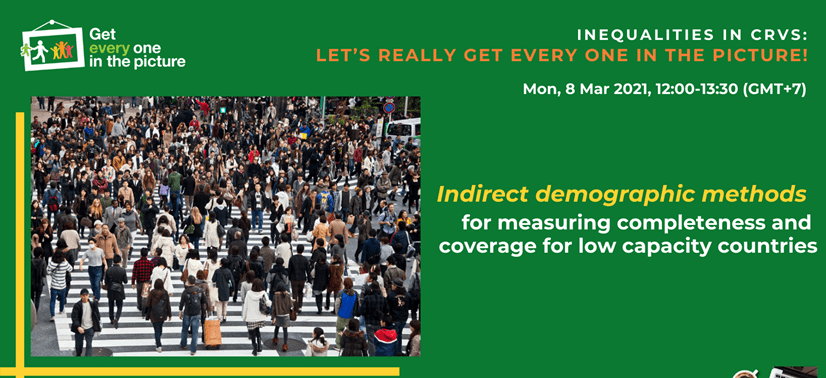
The Asia-Pacific Stats Café Series on "Indirect demographic methods for measuring completeness and coverage for low capacity countries" was held on Monday, 8 March 2021 from 12:00-13:30 (GMT+7).


The Stats Café is the last of a three-seminar series which aims to provide practical and clear guidance for countries in Asia and the Pacific on measuring the inequalities in CRVS with the ultimate goal of narrowing the gap in civil registration. Each seminar comprises of a webinar which is open to all, and a subsequent Expert Group Meeting on the same topic which is by invitation only.

About the session

ESCAP Statistics Division, in collaboration with international and national organizations, is organizing a three-seminar series under the theme, “Inequalities in CRVS: Let’s really get every one in the picture!”. This seminar series aims to provide practical and clear guidance for countries in Asia and the Pacific on measuring the inequalities in CRVS with the ultimate goal of narrowing the gap in civil registration. Each seminar comprises of a webinar which is open to all, and a subsequent Expert Group Meeting on the same topic is by invitation only.

This webinar, speakers shared their knowledge and experiences on indirect demographic methods for measuring completeness and coverage of registration of vital events with focus on their application in low capacity countries.
Moderator

Petra Nahmias
Petra Nahmias
Chief, Population and Social Statistics Section, Statistics Division, ESCAP
Know More

Petra Nahmias is Chief of the Population and Social Statistics Section at the United Nations Economic and Social Commission for Asia and the Pacific (ESCAP). She leads regional work on civil registration and vital statistics, census, migration statistics, citizen data, gender statistics, and data integration, with a focus on strengthening inclusive and effective statistical systems. Previously, she led the statistics team at UNHCR and worked at the UN Population Division, the UK Department for International Development and the Israel Central Bureau of Statistics. She holds a PhD in Sociology and Demography from Princeton University.

Speakers: Part 1: Methods to evaluate completeness of birth registration

Tom Moultrie
Tom Moultrie
Professor and Director, Centre for Actuarial Research(CARe), University of Capetown
Know More

Part 1: Methods to evaluate completeness of birth registration

Fengqing Chao
Fengqing Chao
Post-Doctoral Research Fellow, King Abdullah University of Science and Technology
Know More

Part 1: Methods to evaluate completeness of birth registration

Thomas Spoorenberg
Thomas Spoorenberg
Population Affairs Officer. United Nations Department of Economic and Social Affairs
Know More

Part 1: Methods to evaluate completeness of birth registration

Discussant: Part 1

Shorena Tsiklauri
Shorena Tsiklauri
Head, Population Census and Demographic Statistics Department, National Statistics Office of Georgia (GEOSTAT)
Know More


Speakers: Part 2: Methods to evaluate completeness of death registration

Stephane Helleringer
Professor, Social Research andPublic Policy, NYU Abu Dhabi
Know More

Part 2: Methods to evaluate completeness of death registration

Timothy Adair
Timothy Adair
Principal Research Fellow, Data for Health Initiative, University of Melbourne
Know More

Part 2: Methods to evaluate completeness of death registration


Romesh Silva
Romesh Silva
Senior Technical Specialist, Health & Social Inequalities,Population & DevelopmentBranch, UNFPA
Know More

Part 2: Methods to evaluate completeness of death registration

Discussant: Part 2

Nashrul Wajdi
Nashrul Wajdi
Statistician and Researcher, Statistics Indonesia (Badan Pusat Statistik)
Know More

Discussant: Part 2: Methods to evaluate completeness of death registration


Title Speaker/Presenter PPT
Moderator: Petra Nahmias,  Chief, Population and Social Statistics Section Statistics Division, ESCAP

Part 1: Methods to evaluate completeness of birth registration

a. Lessons learned based on the World Population Prospects Mr. Thomas Spoorenberg, Population Affairs Officer, UN Population Division
b. Estimating completeness of birth registration in South Africa 2011-19 Mr. Tom Moultrie, Professor and Director, Centre for Actuarial Research (CARe), University of Capetown
c. Experience with Bayesian hierarchical model for age-specific fertility rate estimation Ms. Fengqing Chao, Post-Doctoral Research Fellow, King Abdullah University of Science and Technology
Discussant: Ms. Shorena Tsiklauri, Head, Population Census and Demographic Statistics Department, National Statistics Office of Georgia (GEOSTAT)

Part 2: Methods to evaluate completeness of death registration

a. Assessing sex differentials in death registration Mr. Romesh Silva, Senior Technical Specialist, United Nations Fund for Population Activities
b. Empirical completeness method Mr. Timothy Adair, Principal Research Fellow, Data for Health Initiative, University of Melbourne
c. Improving benchmarks for completeness of death registration Mr. Stephane Helleringer, Professor, Social Research and Public Policy, NYU Abu Dhabi
Discussant: Mr. Nashrul Wajdi, Statistician and Researcher, Statistics Indonesia (Badan Pusat Statistik)

for more information, please contact

Statistics Division +66 2288 1234 [email protected]